EBC Webstore
Eastern Book Company

|
|||
|
|||
 Home > LAW BOOKS > Property and Land Laws > Tenancy and Land Laws > 2nd Edition, 2026 Home > LAW BOOKS > Property and Land Laws > Tenancy and Land Laws > 2nd Edition, 2026 |



 5
5
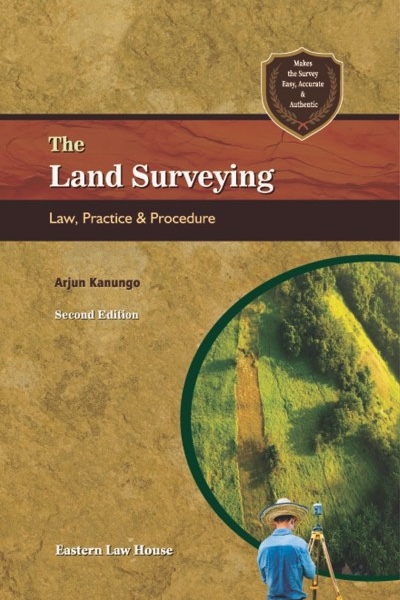
The instant edition of the book offers a comprehensive guide to understanding both traditional and modern surveying techniques. In ancient India, references to the documentation of surveys were found. During the period of Sher Shah it reached its peak by systemization, while with the help of Todarmal, Akbar developed it further into a compact system and subsequently, land survey got the modern scientific touch in the British Period.
The new edition covers fundamental methods such as chain surveying and plane table surveying, along with modern techniques including advanced GPS-based surveying. Each topic is explained with clarity, focusing on real-world application and usability. In addition, the book includes important court rulings and legal orders related to land surveying, providing valuable insight into the legal framework governing survey practices.
Dividing the whole gamut of the subject into 11 chapters, the author has discussed almost all the branches relating to survey lucidly. There are many works after physical measurement, and all of them are arranged in the chapter 'Post Survey Work'. Commissions have an important role in the area of survey. Provisions relating to commission under the Code of Civil Procedure are given in a separate chapter. Conversion is an essential aspect of survey, and it has been dealt with in a separate chapter.
Acts relating to surveys in different States have been added in the Appendices for the convenience of readers to become acquainted with the law relating to the survey.
Key Features:



|
Click on TITLE to choose available options.
|
|
Click on TITLE to choose available options.
|

|
Click on TITLE to choose available options.
|

|
Click on TITLE to choose available options.
|

|
Click on TITLE to choose available options.
|
|
Click on TITLE to choose available options.
|

|
|

|
Click on TITLE to choose available options.
|
|
Click on TITLE to choose available options.
|
|
||
|
||
|