Want a Shipping Estimate? Add an Indian Pin Code, Click Here
This Product
Ships in 3-4 Weeks
Recommend
1
Share
4
Share
2
Share
5
Share
5
Send By e-mail
Verify Phone Number
Please enter the One Time Password (OTP) to verify phone number.
Write your own review
In just a few steps below you can become an online reviewer.
Please click on Continue to submit your review.
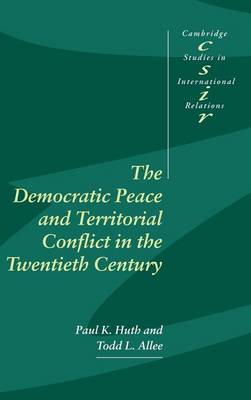
Title: Cambridge Studies in International Relations: Series Number 82: The Democratic Peace and Territorial Conflict in the Twentieth Century
Reviewed By:
Write your review here:
NOTE:HTML is not translated!
Rating:
Share this product on email
Cambridge Studies in International Relations: Series Number 82: The Democratic Peace and Territorial Conflict in the Twentieth Century
Product Details:
Format: Hardback
Publisher: Cambridge University Press
Language: English
Dimensions: 23.00 X 4.00 X 16.00
Publisher Code: 9780521801157
Date Added: 2018-08-06
Search Category: International
Jurisdiction: International
Overview:
This book presents a systematic reassessment of the theoretical and empirical foundations of the democratic peace literature. Three distinct theoretical models of how domestic political institutions shape the foreign policy choices of state leaders are developed and Huth and Allee then test hypotheses from each model against an original data set of 348 territorial disputes from 1919-95. Each territorial dispute is divided into three separate but related phases for empirical analysis: Challenge the Status Quo Stage, Negotiation Stage and Military Escalation Stage. Their statistical results provide strong support for the importance of democratic accountability and norms in shaping decisions to negotiate and settle disputes as well as to threaten force and escalate to war. The findings of this book address central debates and provide many insights into understanding when and why democratic leaders engage in cooperative or confrontational foreign policies.
+ View More
Table Of Contents:
1. Another study of democracy and international conflict?; 2. Pathways to conflict escalation and resolution in international disputes; 3. The international strategic context; 4. Domestic institutions and the political accountability model; 5. Domestic institutions and the political norms model; 6. Domestic institutions and the political affinity model; 7. Empirical results for decisions to challenge the status quo; 8. Empirical results for decisions to offer concessions in negotiations; 9. Empirical results for decisions to escalate with military force; 10. What have we learned about the democratic peace?