Want a Shipping Estimate? Add an Indian Pin Code, Click Here
This Product
Ships in 3-4 Weeks
Recommend
1
Share
4
Share
2
Share
5
Share
5
Send By e-mail
Verify Phone Number
Please enter the One Time Password (OTP) to verify phone number.
Write your own review
In just a few steps below you can become an online reviewer.
Please click on Continue to submit your review.
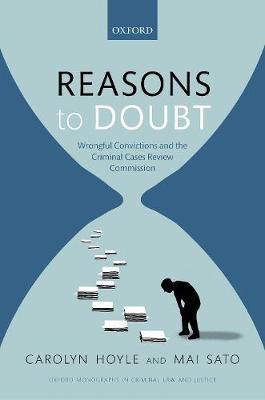
Title: Reasons to Doubt: Wrongful Convictions and the Criminal Cases Review Commission
Reviewed By:
Write your review here:
NOTE:HTML is not translated!
Rating:
Share this product on email
Reasons to Doubt: Wrongful Convictions and the Criminal Cases Review Commission
Product Details:
Format: Hardback
Publisher: Oxford University Press
Language: English
Dimensions: 24.00 X 3.00 X 17.00
Publisher Code: 9780198794578
Date Added: 2018-08-03
Search Category: International
Jurisdiction: International
Overview:
This book reveals what happens to applications for post-conviction review when those in England, Wales, and Northern Ireland who believe they are wrongfully convicted apply to the Criminal Cases Review Commission, the only body that can refer a case back to the Court of Appeal once appellants opportunities for direct appeal are exhausted. While the Court is obliged to hear all such referrals, the Commission can only refer a case where it believes there is a real
possibility that the Court will quash the conviction. The first empirical study of all stages of decision-making within the Commission, this book starts from the premise that the test applied by the Commission (the real possibility test) is not inflexible. Though created by statute and refined through
case law, it must be determined on a case-by-case basis, drawing too on cultural and structural variables, alongside fresh evidence gathered by the Commission.
Through in-depth analysis of case files and interviews, Hoyle and Sato scrutinize the Commissions operational practices, its working rules and assumptions, considering how these influence its understanding of the real possibility test. Situating their rich empirical data within a framework of the Commissions social, organizational, and legal contexts, this book demonstrates that in its open-ended investigations there is considerable scope for discretion; for thorough exploration of all possible
avenues or for choosing a more superficial consideration of a case. It emerges that while structured internal guidance, drawing heavily on Court jurisprudence, shapes decision-making, creating consistency in approach, there remains some variability across cases, over time, that can be accounted for
by the different professional backgrounds and personalities of Commission staff.
+ View More
Table Of Contents:
1: Responding to Wrongful Convictions
2: The Criminal Cases Review Commission: Under-Researched But Under Scrutiny
3: Understanding Discretion at the Commission: A Socio-Legal Approach
4: From Application to Conclusion: How Law, Policy, and Culture Shape Organizational Decision-Making
5: The Nature of Applications to the Commission
6: Triage: the Screening Process-In or Out?
7: Managing Uncertainty in Forensic and Expert Evidence Cases
8: Complainant Credibility in Sexual Offence Cases
9: Responding to Applicants' Allegations of Policing Without Integrity
10: Responding to Applicants' Claims of Inadequate Defence
11: Working Cooperatively with Other Criminal Justice Institutions
12: Managing Efficiency and Thoroughness in Case Review
13: 'Post-Decision Decision-Making': Further Submissions and Reapplications
14: Last Chance for Justice
Appendix
References