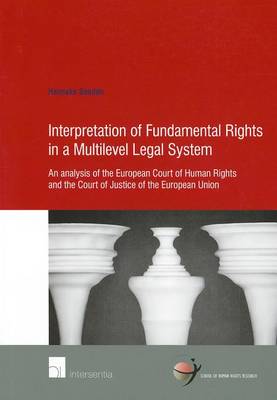
Interpretation of Fundamental Rights in a Multilevel Legal System: An Analysis of the European Court of Human Rights and the Court of Justice of the European Union
Want a Shipping Estimate? Add an Indian Pin Code, Click Here
This Product is
Sold Out
Recommend
1
Share
1
Share
1
Share
0
Share
1
Send By e-mail
Verify Phone Number
Please enter the One Time Password (OTP) to verify phone number.
Write your own review
In just a few steps below you can become an online reviewer.
Please click on Continue to submit your review.
Title: Interpretation of Fundamental Rights in a Multilevel Legal System: An Analysis of the European Court of Human Rights and the Court of Justice of the European Union
Reviewed By:
Write your review here:
NOTE:HTML is not translated!
Rating:
Share this product on email
Interpretation of Fundamental Rights in a Multilevel Legal System: An Analysis of the European Court of Human Rights and the Court of Justice of the European Union
Product Details:
Format: Paperback / softback
Publisher: Intersentia Ltd
Language: English
Dimensions: 24.00 X 0.79 X 17.00
Publisher Code: 9781780680279
Date Added: 2018-08-09
Search Category: International
Jurisdiction: Indian
Overview:
Fundamental rights provisions are known for their relatively vague and general formulation. As a result, judges dealing with these provisions are confronted with many and often controversial interpretative choices. These interpretative choices already present judges operating in a national context with difficulties, but that is even more so for European judges operating in a multilevel context. The European Court of Human Rights (ECtHR) and the Court of Justice of the European Union (CJEU) are often criticized for delivering judgments that contain debatable choices and do not offer sufficient insight into the reasons which have led the courts to make these choices. Especially in a multilevel context where the cooperation of national authorities plays an important role as regards the effectiveness of the European courts, it is important that interpretation methods and principles are used in a transparent manner so that the reasons that justify a specific interpretative choice are clear. This volume analyses the use of a selected number of interpretation methods and principles in the fundamental rights case law of the ECtHR and the CJEU.
The use of teleological, comparative, evolutive and autonomous interpretation by the ECtHR and the CJEU are elaborately discussed on the basis of both legal theoretical literature and case law. The legal theoretical analysis provides the basis for various relevant questions, hypotheses and (analytical) suggestions, that are further studied in the subsequent case law analysis. This leads to a thorough overview of the role of these interpretation methods and principles and the possibilities for improvement. This volume has been written as a PhD Thesis by Hanneke Senden (Institute for Public Law, University of Leiden; presently lawyer at Van Doorne, the Netherlands) in the framework of the research project 'Judicial reasoning in fundamental rights cases - national and European perspectives', supervised by professor J.H. Gerards and funded by the Netherlands Organisation of Scientific Research (NWO).