Want a Shipping Estimate? Add an Indian Pin Code, Click Here
This Product
Ships in 3-4 Weeks
Recommend
1
Share
1
Share
1
Share
0
Share
1
Send By e-mail
Verify Phone Number
Please enter the One Time Password (OTP) to verify phone number.
Write your own review
In just a few steps below you can become an online reviewer.
Please click on Continue to submit your review.
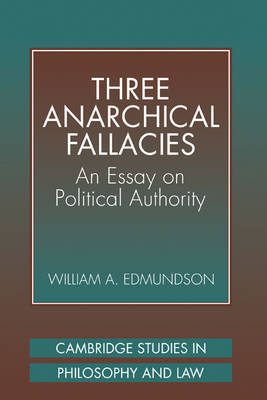
Title: Cambridge Studies in Philosophy and Law: Three Anarchical Fallacies: An Essay on Political Authority
Reviewed By:
Write your review here:
NOTE:HTML is not translated!
Rating:
Share this product on email
Cambridge Studies in Philosophy and Law: Three Anarchical Fallacies: An Essay on Political Authority
Product Details:
Format: Hardback
Publisher: Cambridge University Press
Language: English
Dimensions: 23.00 X 2.00 X 16.00
Publisher Code: 9780521624541
Date Added: 2018-08-05
Search Category: International
Jurisdiction: International
Overview:
How is a legitimate state possible? Obedience, coercion and intrusion are three ideas that seem inseparable from all government and seem to render state authority presumptively illegitimate. This book exposes three fallacies inspired by these ideas and in doing so challenges assumptions shared by liberals, libertarians, cultural conservatives, moderates and Marxists. In three clear and tightly argued essays William Edmundson dispels these fallacies and shows that living in a just state remains a worthy ideal. This is an important book for all philosophers, political scientists and legal theorists as well as other readers interested in the views of Rawls, Dworkin and Nozick, many of whose central ideas are subjected to rigorous critique.
+ View More
Table Of Contents:
Acknowledgements; Introduction; Part I. The Fallacious Argument from the Failure of Political Obligation: 1. Legitimacy and the duty to obey; 2. The correlativity thesis; 3. Legitimate political authority; Part II. The 'Law is Coercive' Fallacy: 4. The concept of coercion; 5. Political theory without coercion; 6. Coercion Redivivus; Part III. The Inner Sphere of Privacy Fallacy: 7. The private sphere; 8. The moral and the social; 9. The social and the political; Conclusion: the state for what?; Index.