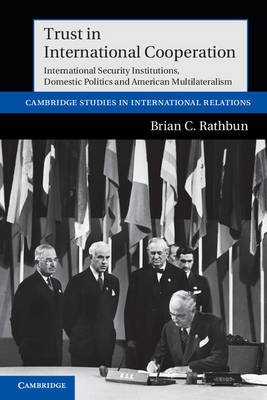
Cambridge Studies in International Relations: Series Number 121: Trust in International Cooperation: International Security Institutions, Domestic Politics and American Multilateralism
Want a Shipping Estimate? Add an Indian Pin Code, Click Here
This Product
Ships in 3-4 Weeks
Recommend
1
Share
4
Share
2
Share
5
Share
5
Send By e-mail
Verify Phone Number
Please enter the One Time Password (OTP) to verify phone number.
Write your own review
In just a few steps below you can become an online reviewer.
Please click on Continue to submit your review.
Title: Cambridge Studies in International Relations: Series Number 121: Trust in International Cooperation: International Security Institutions, Domestic Politics and American Multilateralism
Reviewed By:
Write your review here:
NOTE:HTML is not translated!
Rating:
Share this product on email
Cambridge Studies in International Relations: Series Number 121: Trust in International Cooperation: International Security Institutions, Domestic Politics and American Multilateralism
Product Details:
Format: Paperback / softback
Publisher: Cambridge University Press
Language: English
Dimensions: 23.00 X 1.00 X 15.00
Publisher Code: 9781107603769
Date Added: 2018-08-09
Search Category: International
Jurisdiction: International
Overview:
Trust in International Cooperation challenges conventional wisdoms concerning the part which trust plays in international cooperation and the origins of American multilateralism. Brian C. Rathbun questions rational institutionalist arguments, demonstrating that trust precedes rather than follows the creation of international organizations. Drawing on social psychology, he shows that individuals placed in the same structural circumstances show markedly different propensities to cooperate based on their beliefs about the trustworthiness of others. Linking this finding to political psychology, Rathbun explains why liberals generally pursue a more multilateral foreign policy than conservatives, evident in the Democratic Party's greater support for a genuinely multilateral League of Nations, United Nations and North Atlantic Treaty Organization. Rathbun argues that the post-World War Two bipartisan consensus on multilateralism is a myth, and differences between the parties are growing continually starker.
+ View More
Table Of Contents:
1. Circles of trust: reciprocity, community and multilateralism; 2. Anarchical social capital: a social psychological theory of trust, international cooperation and institutional design; 3. The open circle: the failure of the League of Nations; 4. Squaring the circle: the birth of the United Nations; 5. Closing the circle: the negotiation of the North Atlantic Treaty; 6. Coming full circle: fear, terrorism and the future of American multilateralism.