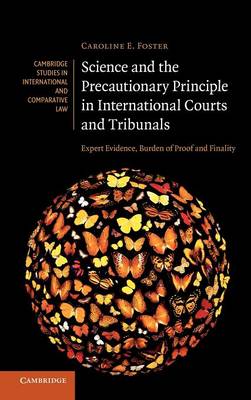
Cambridge Studies in International and Comparative Law: Series Number 79: Science and the Precautionary Principle in International Courts and Tribunals: Expert Evidence, Burden of Proof and Finality
Want a Shipping Estimate? Add an Indian Pin Code, Click Here
This Product
Ships in 3-4 Weeks
Recommend
1
Share
1
Share
1
Share
0
Share
1
Send By e-mail
Verify Phone Number
Please enter the One Time Password (OTP) to verify phone number.
Write your own review
In just a few steps below you can become an online reviewer.
Please click on Continue to submit your review.
Title: Cambridge Studies in International and Comparative Law: Series Number 79: Science and the Precautionary Principle in International Courts and Tribunals: Expert Evidence, Burden of Proof and Finality
Reviewed By:
Write your review here:
NOTE:HTML is not translated!
Rating:
Share this product on email
Cambridge Studies in International and Comparative Law: Series Number 79: Science and the Precautionary Principle in International Courts and Tribunals: Expert Evidence, Burden of Proof and Finality
Product Details:
Format: Hardback
Publisher: Cambridge University Press
Language: English
Dimensions: 23.00 X 3.00 X 15.00
Publisher Code: 9780521513265
Date Added: 2018-08-09
Search Category: International
Jurisdiction: International
Overview:
By canvassing a range of international scientific disputes, including the EC-Biotech and EC-Hormones disputes in the WTO, the case concerning Pulp Mills and the Gabcikovo-Nagymaros case in the International Court of Justice, and the Mox Plant and Land Reclamation cases dealt with under the United Nations Convention on the Law of the Sea, Caroline Foster examines how the precautionary principle can be accommodated within the rules about proof and evidence and advises on the boundary emerging between the roles of experts and tribunals. A new form of reassessment proceedings for use in exceptional cases is proposed. Breaking new ground, this book seeks to advance international adjudicatory practice by contextualising developments in the taking of expert evidence and analysing the justification of and potential techniques for a precautionary reversal of the burden of proof, as well as methods for dealing with important scientific discoveries subsequent to judgements and awards.
+ View More
Table Of Contents:
Part I. Context and Theory: 1. Introduction; 2. Cooperation between disputing parties; Part II. Expert Evidence: 3. Methods for taking expert evidence in scientific disputes; 4. The role of adjudicators and the role of experts; Part III. Burden of Proof: 5. Getting to the heart of the rules on burden of proof; 6. Reversing the burden of proof to give effect to the precautionary principle; Part IV. The Finality of Adjudication: 7. Finality, revision and nullity in scientific cases; 8. Reassessment proceedings and res judicata; 9. Conclusion.