Want a Shipping Estimate? Add an Indian Pin Code, Click Here
This Product
Ships in 3-4 Weeks
Recommend
1
Share
1
Share
1
Share
0
Share
1
Send By e-mail
Verify Phone Number
Please enter the One Time Password (OTP) to verify phone number.
Write your own review
In just a few steps below you can become an online reviewer.
Please click on Continue to submit your review.
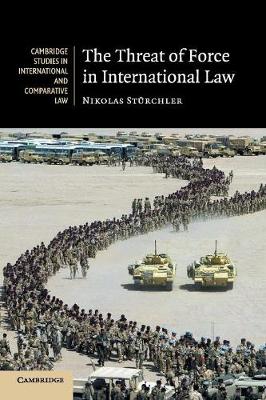
Title: Cambridge Studies in International and Comparative Law: Series Number 53: The Threat of Force in International Law
Reviewed By:
Write your review here:
NOTE:HTML is not translated!
Rating:
Share this product on email
Cambridge Studies in International and Comparative Law: Series Number 53: The Threat of Force in International Law
Product Details:
Format: Paperback / softback
Publisher: Cambridge University Press
Language: English
Dimensions: 23.00 X 1.00 X 15.00
Publisher Code: 9780521133616
Date Added: 2018-08-09
Search Category: International
Jurisdiction: International
Overview:
Threats of force are a common feature of international politics, advocated by some as an economical guarantee against the outbreak of war and condemned by others as a recipe for war. Article 2(4) of the United Nations Charter forbids states to use threats of force, yet the meaning of the prohibition is unclear. This book provides the first comprehensive appraisal of the no-threat principle: its origin, underlying rationale, theoretical implications, relevant jurisprudence, and how it has withstood the test of time from 1945 to the present. Based on a systematic evaluation of state and United Nations practices, the book identifies what constitutes a threat of force and when its use is justified under the United Nations Charter. In so doing, it relates the no-threat principle to important concepts of the twentieth century, such as deterrence, escalation, crisis management, and what has been aptly described as the 'diplomacy of violence'.
+ View More
Table Of Contents:
1. Birth and infancy of a Charter rule: the open framework; 2. The menu of choice: a guide to interpretation; 3. Precedents of the International Court; 4. Deciphering post-Charter practice: means and limits; 5. Open threats to extract concessions; 6. Demonstrations of force; 7. Countervailing threats or threats in self-defence; 8. Findings and conclusions; 9. Epilogue: the law in operation.