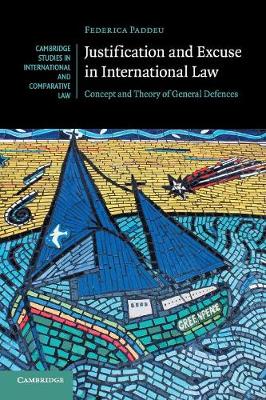
Cambridge Studies in International and Comparative Law: Series Number 130: Justification and Excuse in International Law: Concept and Theory of General Defences
Want a Shipping Estimate? Add an Indian Pin Code, Click Here
This Product
Ships in 3-4 Weeks
Recommend
1
Share
4
Share
2
Share
5
Share
5
Send By e-mail
Verify Phone Number
Please enter the One Time Password (OTP) to verify phone number.
Write your own review
In just a few steps below you can become an online reviewer.
Please click on Continue to submit your review.
Title: Cambridge Studies in International and Comparative Law: Series Number 130: Justification and Excuse in International Law: Concept and Theory of General Defences
Reviewed By:
Write your review here:
NOTE:HTML is not translated!
Rating:
Share this product on email
Cambridge Studies in International and Comparative Law: Series Number 130: Justification and Excuse in International Law: Concept and Theory of General Defences
Product Details:
Format: Paperback / softback
Publisher: Cambridge University Press
Language: English
Dimensions: 23.00 X 3.00 X 15.00
Publisher Code: 9781107513990
Date Added: 2018-08-05
Search Category: International
Jurisdiction: International
Overview:
The defences available to an agent accused of wrongdoing can be considered as justifications (which render acts lawful) or excuses (which shield the agent from the legal consequences of the wrongful act). This distinction is familiar to many domestic legal systems, and tracks analogous notions in moral philosophy and ordinary language. Nevertheless, it remains contested in some domestic jurisdictions where it is often argued that the distinction is purely theoretical and has no consequences in practice. In international law too the distinction has been fraught with controversy, though there are increasing calls for its recognition. This book is the first to comprehensively and thoroughly examine the distinction and its relevance to the international legal order. Combining an analysis of state practice, and historical, doctrinal and theoretical developments, the book shows that the distinction is not only possible in international law but that it is also one that would have important practical implications.
+ View More
Table Of Contents:
Introduction; Part I. Justification and Excuse in International Law: 1. Justification and excuse in international law; 2. Practical consequences of the distinction in international law; 3. Classifying defences into justification and excuse in international law; Part II. Classifying the Defences in the Articles on State Responsibility: 4. Consent; 5. Self-defence; 6. Countermeasures; 7. Force majeure; 8. State of necessity; 9. Distress; Conclusion.