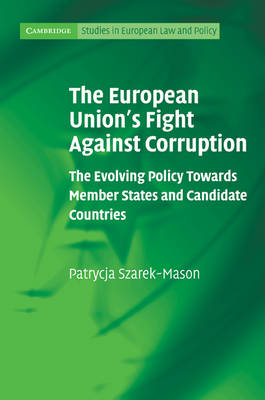
Cambridge Studies in European Law and Policy: The European Union's Fight Against Corruption: The Evolving Policy Towards Member States and Candidate Countries
Want a Shipping Estimate? Add an Indian Pin Code, Click Here
This Product
Ships in 3-4 Weeks
Recommend
1
Share
4
Share
2
Share
5
Share
5
Send By e-mail
Verify Phone Number
Please enter the One Time Password (OTP) to verify phone number.
Write your own review
In just a few steps below you can become an online reviewer.
Please click on Continue to submit your review.
Title: Cambridge Studies in European Law and Policy: The European Union's Fight Against Corruption: The Evolving Policy Towards Member States and Candidate Countries
Reviewed By:
Write your review here:
NOTE:HTML is not translated!
Rating:
Share this product on email
Cambridge Studies in European Law and Policy: The European Union's Fight Against Corruption: The Evolving Policy Towards Member States and Candidate Countries
Product Details:
Format: Hardback
Publisher: Cambridge University Press
Language: English
Dimensions: 23.00 X 2.00 X 16.00
Publisher Code: 9780521113571
Date Added: 2018-08-09
Search Category: International
Jurisdiction: International
Overview:
The fight against corruption emerged as one of the most significant issues during the 2004 enlargement of the EU and gained even more importance with the accession of Romania and Bulgaria in 2007. In order to prepare candidate countries for membership, the EU found it necessary to create new institutions and mechanisms to address corruption. Patrycja Szarek-Mason traces the development of the EU anti-corruption framework, showing how recent enlargements transformed EU policy and highlighting inequities between the treatment of candidate countries and existing Member States. The experience gained during the 2004 enlargement led to a more robust anti-corruption stance during the accession of Bulgaria and Romania and will have implications for future enlargements of the EU. However, the framework can still be strengthened to address corruption adequately and promote higher standards among Member States, especially through greater use of 'soft law' in the form of mutually agreed, non-legally binding policy recommendations.
+ View More
Table Of Contents:
Introduction; 1. Corruption: concept, importance and international response; 2. The scope of EU legal powers and development of the policy in the area of anti-corruption; 3. The EU strategy against corruption within the Member States; 4. Conditionality in the EU accession process; 5. The EU's evaluation of corruption in the Central and Eastern European candidate countries; 6. The EU anti-corruption strategy towards the Central and Eastern European candidate countries: achievement or missed opportunity?; 7. The impact of the 2004 enlargement on the EU anti-corruption policy; Conclusion.