Want a Shipping Estimate? Add an Indian Pin Code, Click Here
This Product
Ships in 3-4 Weeks
Recommend
1
Share
1
Share
1
Share
0
Share
1
Send By e-mail
Verify Phone Number
Please enter the One Time Password (OTP) to verify phone number.
Write your own review
In just a few steps below you can become an online reviewer.
Please click on Continue to submit your review.
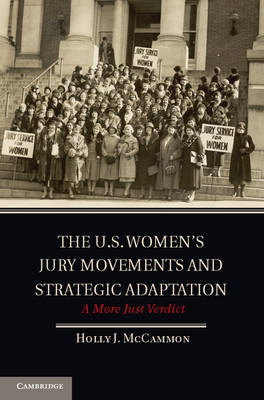
Title: Cambridge Studies in Contentious Politics: The U.S. Women's Jury Movements and Strategic Adaptation: A More Just Verdict
Reviewed By:
Write your review here:
NOTE:HTML is not translated!
Rating:
Share this product on email
Cambridge Studies in Contentious Politics: The U.S. Women's Jury Movements and Strategic Adaptation: A More Just Verdict
Product Details:
Format: Hardback
Publisher: Cambridge University Press
Language: English
Dimensions: 23.00 X 2.00 X 16.00
Publisher Code: 9781107009929
Date Added: 2018-08-05
Search Category: International
Jurisdiction: International
Overview:
When women won the vote in the United States in 1920 they were still routinely barred from serving as jurors, but some began vigorous campaigns for a place in the jury box. This book tells the story of how women mobilized in fifteen states to change jury laws so that women could gain this additional right of citizenship. Some campaigns quickly succeeded; others took substantially longer. The book reveals that when women strategically adapted their tactics to the broader political environment, they were able to speed up the pace of jury reform, while less strategic movements took longer. A comparison of the more strategic women's jury movements with those that were less strategic shows that the former built coalitions with other women's groups, took advantage of political opportunities, had past experience in seeking legal reforms and confronted tensions and even conflict within their ranks in ways that bolstered their action.
+ View More
Table Of Contents:
1. Introduction: the women's jury movements and strategic adaptation; 2. Theorizing social movement strategic adaptation; 3. Broadening women's citizenship: a history of US women's rights; 4. Responding to political defeats; 5. Countering public opposition and indifference; 6. Taking advantage of discursive and cultural opportunities; 7. Turning the movement around; 8. Comparing the movements: qualitative comparative analysis; 9. Final thoughts on strategic adaptation and social movement strategy.