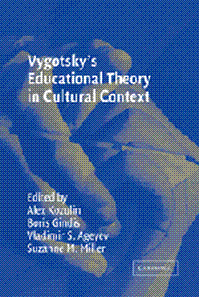
This 2003 book comprehensively covers all major topics of Vygotskian educational theory and its classroom applications. Particular attention is paid to the Vygotskian idea of child development as a consequence rather than premise of learning experiences. Such a reversal allows for new interpretations of the relationships between cognitive development and education at different junctions of the human life span. It also opens new perspectives on atypical development, learning disabilities, and assessment of childrens learning potential. Classroom applications of Vygotskian theory are discussed in the book. Teacher training and the changing role of a teacher in a sociocultural classroom is discussed in addition to the issues of teaching and learning activities and peer interactions. Relevant research findings from the US, Western Europe, and Russia are brought together to clarify the possible new applications of Vygotskian ideas in different disciplinary areas. Contents
List of contributors
Series Foreword
Introduction: sociocultural theory and education: students, teachers and knowledge Alex Kozulin, Boris Gindis, Vladimir S. Ageyev, and Suzanne M. Miller
Part I. Concepts and Paradigms: 1. Psychological tools and mediated learning Alex Kozulin
2. The zone of proximal development in Vygotskys analysis of learning and instruction Seth Chaiklin
3. Vygotskys doctrine of scientific concepts: its role for contemporary education Yuriy V. Karpov
4. Some cognitive tools of literacy Kieran Egan and Natalia Gajdamaschko
5. Dynamic assessment of the evolving cognitive functions in children Carol S. Lidz and Boris Gindis
Part II. Development and Learning: 6. Periods in child development: Vygotskys perspective Holbrook Mahn
7. Development through the lifespan: a neo-Vygotskian approach Yuriy V. Karpov
8. Learning and development of preschool children from the Vygotskian perspective Elena Bodrova and Deborah J. Leong
9. The learning activity in the first years of schooling: the developmental path towards reflection Galina Zuckerman
10. Remediation though education: socio/cultural theory and children with special needs Boris Gindis
Part III. Sociocultural Theory Application in the Classroom: 11. Cultural-historical theory and mathematics education Jean Schmittau
12. Socio/cultural theory and the practice of teaching historical concepts Jacques Haenen, Hubert Schrijuemakers, and Job Stufkens
13. Formation of learning activity and theoretical thinking in science teaching Hartmut Giest and Joaclum Lompscher
14. How literature discussion shapes thinking: ZPDs for teaching/learning habits of the heart and mind Suzanne M. Miller
15. Beyond cognition: a Vygotskian perspective on emotionality and teachers professional lives Anne DiPardo and Christine Potter
Part IV. Diverse Learners and Contexts of Education: 16. Interpersonal communication and internalization in the second language classroom James P. Lantolf
17. Mediation in cognitive socialization: the influence of socioeconomic status Pedro R. Portes and Jennifer A. Vadeboncoeur
18. Cultural modeling: CHAT as a lens for understanding instructional discourse based on African-American English discourse patterns Carol D. Lee
19. The relations of learning and student social class: toward re-socializing sociocultural learning theory Carolyn P. Panofsky
20. Vygotsky in the mirror of cultural interpretations Vladimir S. Agayev
Indexes.
Author/Editor Details
Edited by: Alex Kozulin, International Center for the Enhancement of Learning Potential, Jerusalem
Edited by: Boris Gindis, Touro College, New York
Edited by: Vladimir S. Ageyev, State University of New York, Buffalo
Edited by: Suzanne M. Miller, State University of New York, Buffalo


 Home > LAW BOOKS > Inactive > Society, Politics and Philosophy > General >




 5