Want a Shipping Estimate? Add an Indian Pin Code, Click Here
This Product
Ships in 3-4 Weeks
Recommend
1
Share
4
Share
2
Share
5
Share
5
Send By e-mail
Verify Phone Number
Please enter the One Time Password (OTP) to verify phone number.
Write your own review
In just a few steps below you can become an online reviewer.
Please click on Continue to submit your review.
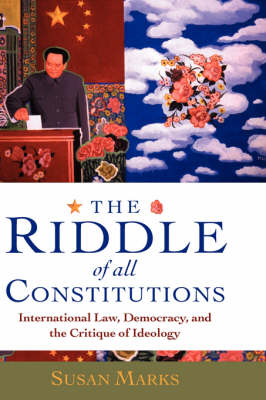
Title: The Riddle of All Constitutions: International Law, Democracy, and the Critique of Ideology
Reviewed By:
Write your review here:
NOTE:HTML is not translated!
Rating:
Share this product on email
The Riddle of All Constitutions: International Law, Democracy, and the Critique of Ideology
Product Details:
Format: Hardback
Publisher: Oxford University Press
Language: English
Dimensions: 24.00 X 2.00 X 17.00
Publisher Code: 9780198267980
Date Added: 2018-08-03
Search Category: International
Jurisdiction: International
Overview:
The promotion of democracy is today a familiar feature of foreign policy and an accepted part of the activities of international organizations. Should international law join in this move to promote democratic political arrangements? If so, on what basis, and with which of the many competing conceptions of democracy? Drawing on an eclectic range of source material, the author examines current debates about the emergence of an international legal `norm of democratic
governance', and considers how proposals for such a norm might be rearticulated to meet some of the concerns to which they give rise. She also uses these debates to illustrate some more general points about approaches to the study of international law. In doing so, she seeks to defend an approach to
international legal scholarship that takes its cue from the tradition of ideology critique.
+ View More
Table Of Contents:
Introduction ; 1. Preface to a Critique of International Legal Ideology ; 2. International Law and the 'Liberal Revolution' ; 3. Limits of the Liberal Revolution I. Low Intensity Democracy ; 4. Limits of the Liberal Revolution II: Pan-National Democracy ; 5. International Law and the Project of Cosmopolitan Democracy ; 6. Afterword: Critical Knowledge