Want a Shipping Estimate? Add an Indian Pin Code, Click Here
This Product
Ships in 3-4 Weeks
Recommend
1
Share
1
Share
1
Share
0
Share
1
Send By e-mail
Verify Phone Number
Please enter the One Time Password (OTP) to verify phone number.
Write your own review
In just a few steps below you can become an online reviewer.
Please click on Continue to submit your review.
Title: The Oxford Handbook of International Law in Armed Conflict
Reviewed By:
Write your review here:
NOTE:HTML is not translated!
Rating:
Share this product on email
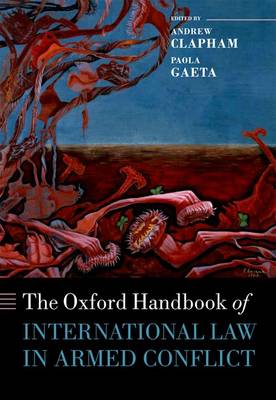
The Oxford Handbook of International Law in Armed Conflict
Product Details:
Contributors: Andrew Clapham, Paola Gaeta
Format: Hardback
Publisher: Oxford University Press
Language: English
Dimensions: 25.00 X 6.00 X 18.00
Publisher Code: 9780199559695
Date Added: 2018-08-05
Search Category: International
Jurisdiction: International
Overview:
Which human rights violations or war crimes allegations result in exclusion from the refugee regime? What human rights protections apply to someone declared an unlawful combatant? Which human rights obligations apply to the actions of armed forces acting abroad? Over the past ten years the content and application of international law in armed conflict has changed dramatically. An authoritative and comprehensive study of the role of international law in armed
conflicts, this Oxford Handbook engages in a broad analysis of international humanitarian law, human rights law, refugee law, international criminal law, environmental law, and the law on the use of force. With an international group of expert contributors, this book has a global, multi-disciplinary
perspective on the place of law in war.
The Handbook consists of 35 Chapters in seven parts. Part A provides the historical background and sets out some of the contemporary challenges. Part B considers the relevant sources of international law. Part C describes the different legal regimes: land warfare, air war fare, maritime warfare, the law of occupation, the law applicable to peace operations, and the law of neutrality. Part D introduces crucial concepts in international humanitarian law: weapons and the concepts of superfluous
injury and unnecessary suffering, the principle of distinction, proportionality, genocide and crimes against humanity, grave breaches and war crimes, and internal armed conflict. Part E looks at fundamental rights: the right to life, the prohibition on torture, the right to fair trial, economic,
social and cultural rights, the protection of the environment, the protection of cultural property, the human rights of the members of the armed forces, and the protection of children. Part F covers important issues such as: the use of force, terrorism, unlawful combatants, the application of human rights in times of armed conflict, refugee law, and the issues of gender in times of armed conflict. Part G deals with accountability issues including those related to private security companies and
armed groups, as well as questions of state responsibility brought before national courts and issues related to transitional justice.
+ View More
Table Of Contents:
A. INTRODUCTION ; B. SOURCES ; C. LEGAL REGIMES ; D. KEY CONCEPTS FOR HUMANITARIAN LAW ; E. KEY RIGHTS IN TIMES OF ARMED CONFLICT ; F. KEY ISSUES IN TIMES OF ARMED CONFLICT ; G. ANSWERING FOR VIOLATIONS OF THE LAW ; CONCLUSION