EBC Webstore
Eastern Book Company

|
|||
|
|||
 Home > 16th Edition, 2013 Home > 16th Edition, 2013 |



 5
5
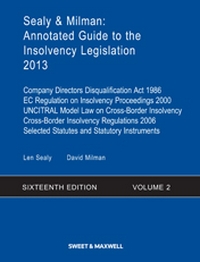
The new 16th edition of Sealy & Milman: Annotated Guide to the Insolvency Legislation 2013 gives you full coverage, concise analysis and annotated interpretation of corporate and personal insolvency, written by leading expert authors. Widely regarded as the key work for those advising in insolvency, this established legislation handbook provides expert annotated commentary and clarification on the legal and practical implications of the insolvency legislation.
Sealy & Milman includes additional comprehensive commentary on the very latest case law and considers the consequences of these decisions for both corporate and personal insolvency. It covers the new debt relief order procedure (introduced in 2009), as well as including the 2012 Practice Direction on Insolvency Proceedings, and comments on upcoming reforms to be made via Enterprise and Regulatory Reform Bill.
Legislation
In corporate insolvency, the Companies Act 2006 (Amendment of Part 25) Regulations 2013 will introduce from April 6, 2013 the long-promised reform of the system of registration of company charges. The full text has been included in Volume 2.
The Financial Services Act 2012 will also become operative in April, 2013, bringing about the complete restructuring of the regulation of banking and financial services in this country. We have noted the effects of this legislation so far as concerns insolvency law in Vol.2 and in the commentary.
The reforms made by the Charities Act 2011 which provide for the new CIO (Charitable Incorporated Organisation), with its own insolvency regime, have come into force.
There has been no substantive reform in the area of personal insolvency, but a number of minor and technical changes have all been incorporated.
We are now on the verge of reforms to be introduced via the Enterprise and Regulatory Reform Bill, which will establish a new administrative procedure for the disposal of bankruptcy cases out of court by involving the use of Adjudicators. This legislation had not been finalised by the date of submission of manuscript but we have referred to it in passing wherever appropriate.
Proposals for reforming the EC Regulation on Cross-Border Insolvency have recently been published which, when enacted, will broaden the scope of the Regulation and extend its focus so as to give added emphasis to rescue and rehabilitation procedures. Details of these proposals have been included.
All other legislation has been fully updated.
Case-law
All the cases of significance reported in the past twelve months have been incorporated into the commentary.
In the corporate field, the important decision of the Supreme Court in the conjoined appeals Rubin v Eurofinance SA and New Cap Reinsurance Corp Ltd v Grant [2012] UKSC 46 has imposed constraints upon the enforcement of judgments in foreign insolvency proceedings, checking the incipient development of a wider common-law jurisdiction in this area.
Among decisions of the Court of Appeal we may note Re Globespan Airways Ltd [2012] EWCA Civ 1159 (notice of conversion from administration to winding up effective only when actually registered, and not from the date filed at Companies House), Re Nortel GmbH, Bloom v Pensions Regulator [2011] EWHC Civ 1124 (priority in administration of a financial support direction under the Pensions Act 1995) and Cathie v Secretary of State for Business, Innovation and Skills [2012] EWCA Civ 739 (onus of proof in director disqualification cases).
At first instance level, there has been much public interest in HM Revenue and Customs Commissioners v The Football League Ltd [2012] EWHC 1372 (Ch) (legality of the “football creditor” rule), Re Wedgwood Museum Trust Ltd [2011] EWHC 3782 (Ch) (trust held not to have been legally constituted) and the comments of Peter Smith J on the failure of the disqualification proceedings against the directors of Farepak Food & Gifts Ltd, resulting in the report by the Insolvency service published in December, 2012. The extensive (and as yet by no means fully settled) spate of litigation on defective administrator appointments (deriving from Minmar (929) Ltd v Khalastchi [2011] EWHC 11559 (Ch), and extending to at least 15 later cases, including several unreported), and the retrospective validation of such appointments is fully discussed.
In personal insolvency, the ruling of the Court of Appeal in Bramston v Haut [2012] EWCA Civ 1637 has restored the position with regard to the policy of non intervention by the courts with regard to the actions of a trustee in bankruptcy, save in cases of perversity. The Court of Appeal has given further guidance on the impact of the Debtor Relief Order moratorium in Irwell Valley Housing Ltd v Docherty [2012] EWCA Civ 704. The issue of the publicity attached to the rescission of a bankruptcy order has been explained by the Court of Appeal in Smeaton v Equifax plc [2013] EWCA Civ 108. At first instance level, the decision in Raithatha v Williamson [2012] 1 WLR 3559 will enhance the utility of income payment orders. The unusual facts of Appleyard v Wewelwala [2012] EWHC 3302 (Ch) have disclosed a lacuna in the law where a bankruptcy order is successfully appealed.
Looking at the picture on the ground we are witnessing a continued decline in the usage of bankruptcy, largely brought about by the phenomenal “success” of debt relief orders, which have diverted many cases that would otherwise have produced customers for debtor-petitioned bankruptcies. IVAs are now very much the pre-eminent personal insolvency regime. This development is reflected in the commentary.


|

Click on TITLE to choose available options.
|
|
Click on TITLE to choose available options.
|

|
Click on TITLE to choose available options.
|

|
Click on TITLE to choose available options.
|

|
Click on TITLE to choose available options.
|
|
Click on TITLE to choose available options.
|

|
|

|
Click on TITLE to choose available options.
|
|
Click on TITLE to choose available options.
|
|
|
|
||
|
||
|