EBC Webstore
Eastern Book Company

|
|||
|
|||
 Home > LAW BOOKS > Inactive > Society, Politics and Philosophy > General > |




 5
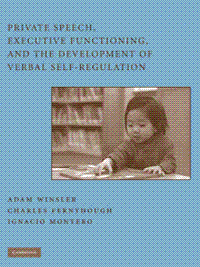
Seventy-five years after Vygotskys death, scholarship exploring developmental relations between language and thought continues to be strong. This timely edited volume compiles contributions from international leaders in the field on the roles of language and private speech (self-talk) in the development of self-regulation and executive functioning in children and adults. New theoretical insights, empirical research, and potential clinical and educational applications of scholarship on private speech are presented. Relevant for undergraduate and graduate students and scholars of psychology, education, linguistics, and cognitive science, this text will be an essential volume for those interested in the interface between language, cognition, and behaviour, and the development of regulatory or cognitive control over behaviour. Contents
Preface Laura Berk
Introduction/Overview Adam Winsler, Charles Fernyhough and Ignacio Montero
Part I. Overview, Theoretical, and Biological Foundations:
1. Still talking to ourselves after all these years: a review of current research on private speech Adam Winsler
2. Dialogic thinking Charles Fernyhough
3. The executive functions of language in preschool children Ulrich Mller, Sophie Jaques, Karin Brocki and Philip David Zelazo
4. The neuropsychology of covert and overt speech: implications for the study of private speech in children and adults Simon Jones
Part II. Language, Communication, Social Cognition and Awareness:
5. Talking and thinking: the role of speech in social understanding Jeremy Carpendale, Charles Lewis, Noah Susswein and Joanna Lunn
6. Private speech and theory of mind: evidence for developing functional relations Charles Fernyhough and Elizabeth Meins
7. Development of communicative competence through private and inner speech Peter Feigenbaum
8. Private speech in the framework of referential communication Conchi San Martn Martinez, Humbert Boada and Maria Forns Santacana
9. Preschool childrens awareness and theory of speech Louis Manfra
1. Younger childrens knowledge about overt and covert private speech John Flavell and Adrian A. Wong
Part III. Symbols and Tools Throughout the Lifespan:
11. Private pointing and private speech: development of executive function Begoa Delgado, Juan Carolos Gmez and Encarnacin Sarri
12. Symbols as tools in the development of executive function Stephanie Carlson and Danielle M. Beck
13. On the persistence of private speech: empirical and theoretical considerations Robert M. Duncan and Donato Tartulli
14. Private speech beyond childhood: testing the developmental hypothesis Jos Snchez-Medina, David Alarcn Rubio and Manuel de la Mata
Part IV. Motivational and Educational Applications:
15. Private speech and motivation: the role of language in a sociocultural account of motivational processes David J. Atencio and Ignacio Montero
16. Creativity and private speech in young children C. Stephen White and Martha Daugherty
17. Early childhood teachers awareness, beliefs, and practices toward childrens private speech Carla Deniz
Afterword James Wertsch.


|

Click on TITLE to choose available options.
|
|
Click on TITLE to choose available options.
|

|
Click on TITLE to choose available options.
|

|
Click on TITLE to choose available options.
|

|
Click on TITLE to choose available options.
|
|
Click on TITLE to choose available options.
|

|
|

|
Click on TITLE to choose available options.
|
|
Click on TITLE to choose available options.
|
|
||
|
||
|