Want a Shipping Estimate? Add an Indian Pin Code, Click Here
This Product
Ships in 3-4 Weeks
Recommend
1
Share
4
Share
2
Share
5
Share
5
Send By e-mail
Verify Phone Number
Please enter the One Time Password (OTP) to verify phone number.
Write your own review
In just a few steps below you can become an online reviewer.
Please click on Continue to submit your review.
Title: Ordinary Meaning: A Theory of the Most Fundamental Principle of Legal Interpretation
Reviewed By:
Write your review here:
NOTE:HTML is not translated!
Rating:
Share this product on email
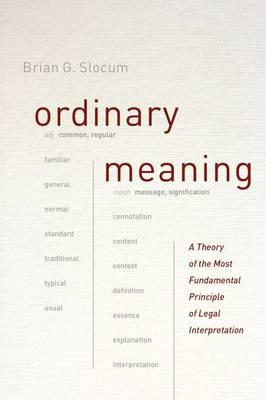
Ordinary Meaning: A Theory of the Most Fundamental Principle of Legal Interpretation
Product Details:
Format: Hardback
Publisher: The University of Chicago Press
Language: English
Dimensions: 0.00 X 0.79 X 0.00
Publisher Code: 9780226304854
Date Added: 2018-08-03
Search Category: International
Jurisdiction: International
Overview:
Consider this court case: a defendant has traded a gun for drugs, and there is a criminal sentencing provision that stipulates an enhanced punishment if the defendant "uses" a firearm "during and in relation to a drug trafficking crime." Buying the drugs was obviously a crime - but can it be said that the defendant actually "used" the gun? This is the sort of question at the heart of legal interpretation. The field is built around one key question: by what standard should legal texts be interpreted? The traditional doctrine is that words should be given their "ordinary meaning": words in legal texts should be interpreted in light of accepted standards of communication. Yet often, courts fail to properly consider context, refer to unsuitable dictionary definitions, or otherwise misconceive how the ordinary meaning of words should be determined. In this book, Brian Slocum builds his argument for a new method of interpretation by asking glaring, yet largely ignored, questions. What makes one particular meaning the "ordinary" one, and how exactly do courts conceptualize the elements of ordinary meaning?
Ordinary Meaning provides a much-needed, revised framework, boldly instructing those involved with the law in how the components of ordinary meaning should properly be identified and developed in our modern legal system.