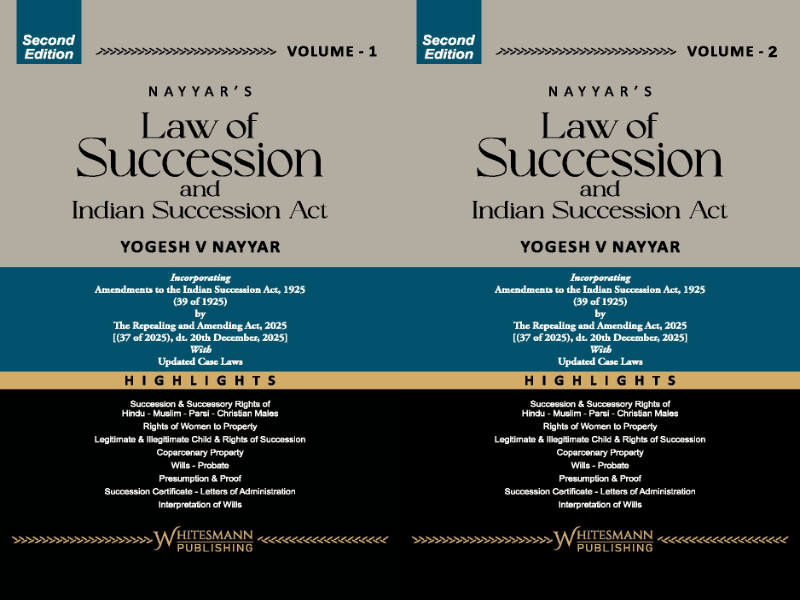
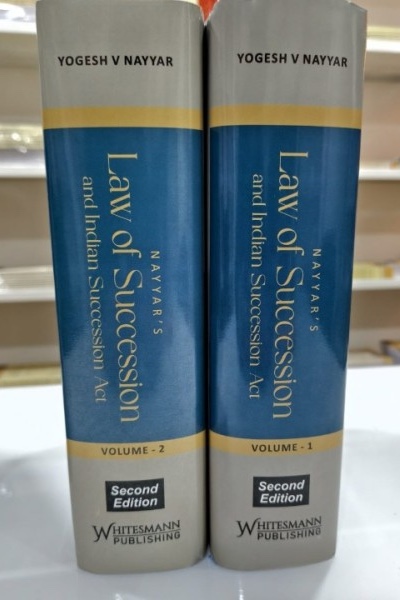
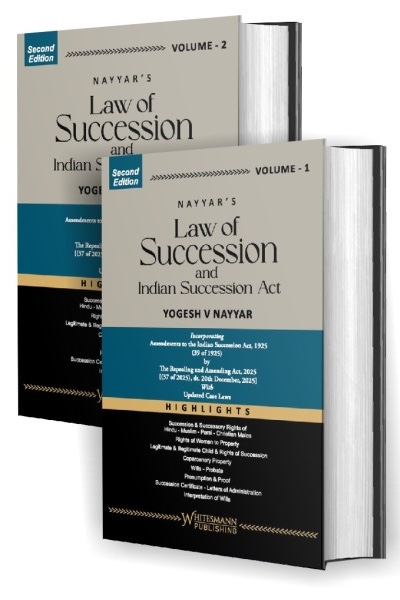
Law of Succession and Indian Succession Act (In 2 Volumes) by Yogesh V Nayyar (2nd Edition, 2026) is an authoritative and comprehensive treatise on succession laws in India, incorporating amendments to the Indian Succession Act, 1925 introduced by the Repealing and Amending Act, 2025. The work systematically examines the legal framework governing the devolution of property upon death, covering both testamentary and intestate succession across diverse personal laws in India.
The two-volume set presents a structured and analytical discussion on succession principles applicable to Hindus, Muslims, Christians, Parsis, and other communities, reflecting the evolving judicial approach of Indian courts. It integrates recent and landmark judicial pronouncements, including significant rulings of the Supreme Court of India, ensuring readers gain clarity on contemporary interpretations and practical application of the law. The edition is fully updated with the latest case laws, statutory developments, and doctrinal insights, making it a dependable reference for understanding both foundational concepts and nuanced legal issues in succession jurisprudence.
Key Features:
- Incorporates the statutory amendments to the Indian Succession Act, 1925, made by the Repealing and Amending Act, 2025.
- Detailed commentary on coparcenary property and succession under Hindu law, including developments relating to daughters? rights.
- Comprehensive treatment of testamentary succession, including execution, attestation, revocation, and construction of wills.
- Exhaustive analysis of probate proceedings, letters of administration, and succession certificates.
- In-depth discussion on presumption, burden of proof, and evidentiary aspects in succession disputes.
- Coverage of escheat and devolution of property in the absence of legal heirs.
- Comparative treatment of succession rights of Hindu, Muslim, Christian, and Parsi males and females.
- Critical examination of judicial trends through updated Supreme Court and High Court decisions.
- Practical insights into procedural aspects relevant for civil litigation involving succession matters.
This two-volume commentary is ideally suited for advocates practicing in civil, testamentary, and property matters; judges and judicial officers dealing with succession disputes; academicians and researchers specializing in personal laws and property law; and postgraduate law students seeking an in-depth doctrinal and case-based understanding of succession jurisprudence in India.


 Home > LAW BOOKS > Family and Personal Laws > Wills, Probate and Succession > 2nd Edition, 2026


 5
5