Want a Shipping Estimate? Add an Indian Pin Code, Click Here
This Product
Ships in 3-4 Weeks
Recommend
1
Share
4
Share
2
Share
5
Share
5
Send By e-mail
Verify Phone Number
Please enter the One Time Password (OTP) to verify phone number.
Write your own review
In just a few steps below you can become an online reviewer.
Please click on Continue to submit your review.
Title: International Organizations and their Exercise of Sovereign Powers
Reviewed By:
Write your review here:
NOTE:HTML is not translated!
Rating:
Share this product on email
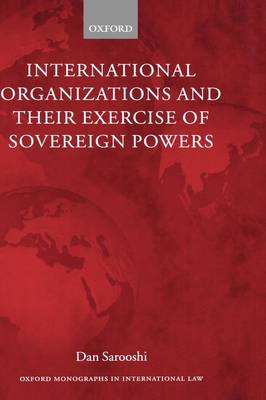
International Organizations and their Exercise of Sovereign Powers
Product Details:
Format: Hardback
Publisher: Oxford University Press
Language: English
Dimensions: 24.00 X 2.00 X 17.00
Publisher Code: 9780199283255
Date Added: 2018-08-05
Search Category: International
Jurisdiction: International
Overview:
This book provides a conceptual and legal analysis of one of the most important challenges facing international organizations today: their exercise of sovereign powers. The book examines the exercise of sovereign powers by organizations such as the United Nations, the World Trade Organization, and the European Union. It makes a significant contribution to the content of the law that governs both the exercise of sovereign powers by international organizations and the
relationships between organizations and their Member States. The book also tackles the fundamental question of what values should constrain international organizations in their exercise of sovereign powers.
These sovereign powers have been conferred on international organizations by States and may include the full range of executive, legislative, and judicial powers. Sarooshi develops an innovative three-tiered typology of conferrals which ranges from agency relationships, to delegations of powers, to full transfers of powers. These categories prove useful in answering a number of legal issues that arise out of the relationships between international organizations and their Member States. These
include: When an international organization exercises conferred powers, does it do so on its own behalf or on behalf of the State? Whose legal relations are changed by the exercise of powers: the State's or the organization's? In the case where the State has retained the right to exercise powers it has
conferred on an organization, whose interpretation of the powers will prevail in the case of a conflict that arises from the concurrent exercise of powers? What fiduciary duties are owed by the organization and Member States towards each other? And who is responsible for breaches of international law that may occur as a result of the organization's exercise of conferred powers: the State or the organization or both? These issues lead on to a consideration in the book of the measures available
to a State under international law when it wants to try and change the way that an organization is exercising conferred powers.
+ View More
Table Of Contents:
Foreword ; Table of cases ; Introduction ; 1: International Organizations as a Forum for the Contestation of Sovereign Powers ; 2: The Processes by which States Confer Powers on International Organizations ; 3: Conferrals by States of Powers on International Organizations: A Typology ; 4: Agency relationships between States and International Organizations ; 5: The Delegation of Powers to International Organizations ; 6: The Ceding of Powers to International Organizations ; 7: Measures a State can Take Against an International Organization on which it has Conferred Powers ; Concluding Remarks ; Bibliography ; Index