Want a Shipping Estimate? Add an Indian Pin Code, Click Here
This Product
Ships in 3-4 Weeks
Recommend
1
Share
4
Share
2
Share
5
Share
5
Send By e-mail
Verify Phone Number
Please enter the One Time Password (OTP) to verify phone number.
Write your own review
In just a few steps below you can become an online reviewer.
Please click on Continue to submit your review.
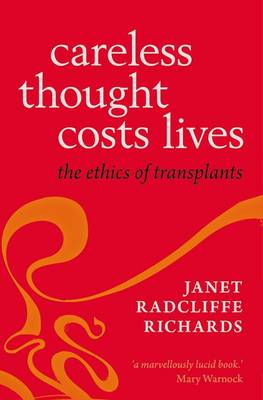
Title: Careless Thought Costs Lives: The Ethics of Transplants
Reviewed By:
Write your review here:
NOTE:HTML is not translated!
Rating:
Share this product on email
Careless Thought Costs Lives: The Ethics of Transplants
Product Details:
Format: Paperback / softback
Publisher: Oxford University Press
Language: English
Dimensions: 20.00 X 2.00 X 13.00
Publisher Code: 9780199678778
Date Added: 2018-08-10
Search Category: International
Jurisdiction: International
Overview:
Everyone knows that transplantation can save and transform lives, but thousands die every year on waiting lists because there are not enough organs available. If more people could be persuaded to donate, more lives could be saved. But is individual reluctance to donate the root of the problem? Individual choices are made against the background of prevailing laws, conventions and institutions, and many of those present direct or indirect obstacles to organ
procurement, from both the living and the dead. If any of those cannot be justified, the deaths they cause are similarly unjustified.
In The Ethics of Transplants, Janet Radcliffe Richards, a leading moral philosopher and author of The Sceptical Feminist and Human Nature after Darwin, casts a sharp critical eye over these institutional barriers to organ procurement, and the logic of the arguments offered in their defence. Her incisive reasoning forces us to confront the implications of unexamined intuitions, leads to several unexpected conclusions, and in doing so demonstrates the crucial
importance of clear thinking in public debate. Originally published in hardback as The Ethics of Transplants.
+ View More
Table Of Contents:
1. Introduction ; 2. Procurement from the living ; 3. Methodological models ; 4. Procurement from the dead ; 5. Penumbral problems ; 6. Conclusion