Want a Shipping Estimate? Add an Indian Pin Code, Click Here
This Product
Ships in 3-4 Weeks
Recommend
1
Share
4
Share
2
Share
5
Share
5
Send By e-mail
Verify Phone Number
Please enter the One Time Password (OTP) to verify phone number.
Write your own review
In just a few steps below you can become an online reviewer.
Please click on Continue to submit your review.
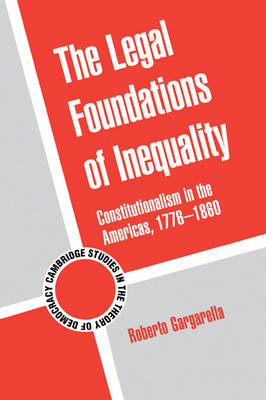
Title: Cambridge Studies in the Theory of Democracy: Series Number 8: The Legal Foundations of Inequality: Constitutionalism in the Americas, 1776-1860
Reviewed By:
Write your review here:
NOTE:HTML is not translated!
Rating:
Share this product on email
Cambridge Studies in the Theory of Democracy: Series Number 8: The Legal Foundations of Inequality: Constitutionalism in the Americas, 1776-1860
Product Details:
Format: Hardback
Publisher: Cambridge University Press
Language: English
Dimensions: 22.00 X 3.00 X 15.00
Publisher Code: 9780521195027
Date Added: 2018-08-05
Search Category: International
Jurisdiction: International
Overview:
The long revolutionary movements that gave birth to constitutional democracies in the Americas were founded on egalitarian constitutional ideals. They claimed that all men were created equal with similar capacities and also that the community should become self-governing. Following the first constitutional debates that took place in the region, these promising egalitarian claims, which gave legitimacy to the revolutions, soon fell out of favor. Advocates of a conservative order challenged both ideals and favored constitutions that established religion and created an exclusionary political structure. Liberals proposed constitutions that protected individual autonomy and rights but established severe restrictions on the principle of majority rule. Radicals favored an openly majoritarian constitutional organization that, according to many, directly threatened the protection of individual rights. This book examines the influence of these opposite views during the 'founding period' of constitutionalism in countries including the United States, Argentina, Colombia, Chile, Ecuador, Mexico, Peru, and Venezuela.
+ View More
Table Of Contents:
1. Radicalism: honoring the 'general will'; 2. Conservatism: the moral cement of society; 3. Liberalism: between tyranny and anarchy; 4. The quest for equality.