Want a Shipping Estimate? Add an Indian Pin Code, Click Here
This Product
Ships in 3-4 Weeks
Recommend
1
Share
4
Share
2
Share
5
Share
5
Send By e-mail
Verify Phone Number
Please enter the One Time Password (OTP) to verify phone number.
Write your own review
In just a few steps below you can become an online reviewer.
Please click on Continue to submit your review.
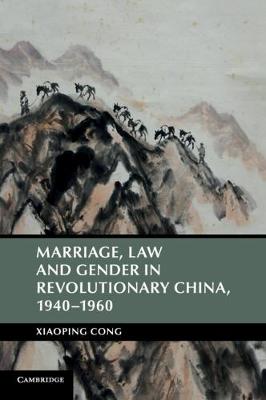
Title: Cambridge Studies in the History of the People's Republic of China: Marriage, Law and Gender in Revolutionary China, 1940-1960
Reviewed By:
Write your review here:
NOTE:HTML is not translated!
Rating:
Share this product on email
Cambridge Studies in the History of the People's Republic of China: Marriage, Law and Gender in Revolutionary China, 1940-1960
Product Details:
Format: Paperback / softback
Publisher: Cambridge University Press
Language: English
Dimensions: 0.00 X 0.79 X 0.00
Publisher Code: 9781316602614
Date Added: 2018-08-11
Search Category: International
Jurisdiction: International
Overview:
Xiaoping Cong examines the social and cultural significance of Chinese revolutionary legal practice in the construction of marriage and gender relations. Her book is an empirically rich investigation of the ways in which a 1943 legal dispute over an arranged marriage in a Chinese village became a legal, political and cultural exemplar on the national stage. This conceptually groundbreaking study revisits the Chinese Revolution and its impact on women and society by presenting a Chinese experience that cannot and should not be theorized in the framework of Western discourse. Taking a cultural-historical perspective, Cong shows how the Chinese Revolution and its legal practices produced new discourses, neologisms and cultural symbols that contained China's experience in twentieth-century social movements, and how revolutionary practice was sublimated into the concept of 'self-determination', an idea that bridged local experiences with the tendency of the twentieth-century world, and that is a revolutionary legacy for China today.
+ View More
Table Of Contents:
Introduction; Part I. Locality, Marriage Practice and Women: 1. The case of Feng v. Zhang: marriage reform in a revolutionary region; 2. The appeal: women, love, marriage, and the revolutionary state; Part II. Legal Practice and New Principle: 3. The new adjudication: the judicial construction in marriage reform; 4. A new principle in the making: from 'freedom' to 'self-determination' of marriage through legal practice; Part III. Politics and Gender in Construction: 5. Newspaper reports: casting a new democracy in village communities; 6. The Qin opera and the ballad: from rebellious daughters to social mothers; 7. The Ping opera and movie: nationalizing the new marriage practice and politicizing the state-family, 1949-1960; Epilogue: 'Liu Qiao'er', law, and zi-zhu: beyond 1960; Bibliography; Index.