Want a Shipping Estimate? Add an Indian Pin Code, Click Here
This Product
Ships in 3-4 Weeks
Recommend
1
Share
1
Share
1
Share
0
Share
1
Send By e-mail
Verify Phone Number
Please enter the One Time Password (OTP) to verify phone number.
Write your own review
In just a few steps below you can become an online reviewer.
Please click on Continue to submit your review.
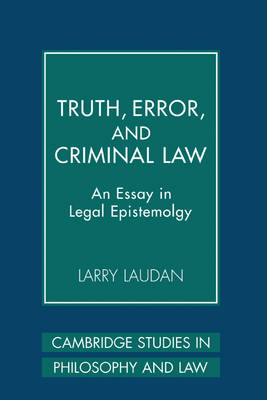
Title: Cambridge Studies in Philosophy and Law: Truth, Error, and Criminal Law: An Essay in Legal Epistemology
Reviewed By:
Write your review here:
NOTE:HTML is not translated!
Rating:
Share this product on email
Cambridge Studies in Philosophy and Law: Truth, Error, and Criminal Law: An Essay in Legal Epistemology
Product Details:
Format: Hardback
Publisher: Cambridge University Press
Language: English
Dimensions: 23.00 X 2.00 X 15.00
Publisher Code: 9780521861663
Date Added: 2018-08-06
Search Category: International
Jurisdiction: International
Overview:
Beginning with the premise that the principal function of a criminal trial is to find out the truth about a crime, Larry Laudan examines the rules of evidence and procedure that would be appropriate if the discovery of the truth were, as higher courts routinely claim, the overriding aim of the criminal justice system. Laudan mounts a systematic critique of existing rules and procedures that are obstacles to that quest. He also examines issues of error distribution by offering the first integrated analysis of the various mechanisms - the standard of proof, the benefit of the doubt, the presumption of innocence and the burden of proof - for implementing society's view about the relative importance of the errors that can occur in a trial.
+ View More
Table Of Contents:
1. Thinking about error in the law; 2. The unraveling of reasonable doubt; 3. Fixing the standard of proof; 4. Innocence, the burden of proof, and the puzzle of affirmative defenses; 5. Evaluating evidence and procedures; 6. Silent defendants, silent witnesses, and lobotomized jurors; 7. Confessions, poison fruit, and other exclusions; 8. Double jeopardy and false acquittals: letting felons and judges off the hook?; 9. Dubious motives for flawed rules: the clash between values.