Want a Shipping Estimate? Add an Indian Pin Code, Click Here
This Product
Ships in 3-4 Weeks
Recommend
1
Share
4
Share
2
Share
5
Share
5
Send By e-mail
Verify Phone Number
Please enter the One Time Password (OTP) to verify phone number.
Write your own review
In just a few steps below you can become an online reviewer.
Please click on Continue to submit your review.
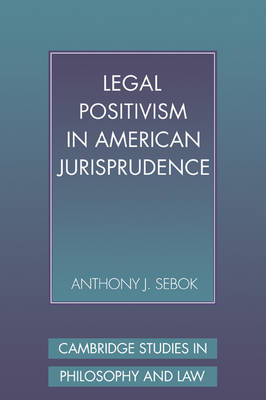
Title: Cambridge Studies in Philosophy and Law: Legal Positivism in American Jurisprudence
Reviewed By:
Write your review here:
NOTE:HTML is not translated!
Rating:
Share this product on email
Cambridge Studies in Philosophy and Law: Legal Positivism in American Jurisprudence
Product Details:
Format: Paperback / softback
Publisher: Cambridge University Press
Language: English
Dimensions: 23.00 X 2.00 X 15.00
Publisher Code: 9780521057165
Date Added: 2018-08-09
Search Category: International
Jurisdiction: International
Overview:
This book represents a serious and philosophically sophisticated guide to modern American legal theory, demonstrating that legal positivism has been a misunderstood and underappreciated perspective through most of twentieth-century American legal thought. Anthony Sebok traces the roots of positivism through the first half of the twentieth century, and rejects the view that one must adopt some version of natural law theory in order to recognize moral principles in the law. On the contrary, once one corrects for the mistakes of formalism and postwar legal process, one is left with a theory of legal positivism that takes moral principles seriously while avoiding the pitfalls of natural law. The broad scope of this book ensures that it will be read by philosophers of law, historians of law, historians of American intellectual life, and those in political science concerned with public law and administration.
+ View More
Table Of Contents:
Acknowlegments; 1. Why study legal positivism; 2. Positivism and formalism; 3. The varieties of formalism; 4. Legal process and the shadow of positivism; 5. The false choice between the Warren Court and legal process; 6. Fundamental rights and the problem of insatiability; 7. New legal positivism and the incorporation of morality.