Want a Shipping Estimate? Add an Indian Pin Code, Click Here
This Product
Ships in 3-4 Weeks
Recommend
1
Share
4
Share
2
Share
5
Share
5
Send By e-mail
Verify Phone Number
Please enter the One Time Password (OTP) to verify phone number.
Write your own review
In just a few steps below you can become an online reviewer.
Please click on Continue to submit your review.
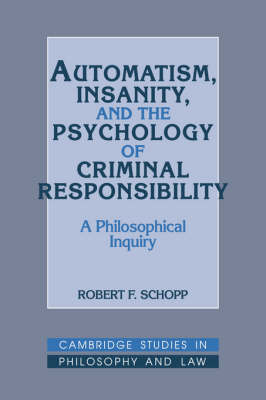
Title: Cambridge Studies in Philosophy and Law: Automatism, Insanity, and the Psychology of Criminal Responsibility: A Philosophical Inquiry
Reviewed By:
Write your review here:
NOTE:HTML is not translated!
Rating:
Share this product on email
Cambridge Studies in Philosophy and Law: Automatism, Insanity, and the Psychology of Criminal Responsibility: A Philosophical Inquiry
Product Details:
Format: Hardback
Publisher: Cambridge University Press
Language: English
Dimensions: 23.00 X 2.00 X 15.00
Publisher Code: 9780521401500
Date Added: 2018-08-08
Search Category: International
Jurisdiction: International
Overview:
This is a book about the role that psychological impairment should play in a theory of criminal liability. Criminal guilt in the Anglo-American legal tradition requires both that the defendant committed some proscribed act and did so with intent, knowledge, or recklessness. The second requirement corresponds to the intuitive idea that people should not be punished for something they did not do 'on purpose' or if they 'did not realize what they were doing'. Unlike many works in this area, this book addresses the automatism and insanity defences by examining the types of functional impairment that typical candidates for these defences actually suffer. What emerges is a much wider conceptual framework that allows us to understand the significance of psychological states and processes for the attribution of criminal responsibility in a manner that is logically coherent, morally defensible, and consistent with research in psychopathology.
+ View More
Table Of Contents:
Preface; Acknowledgments; 1. Introduction; 2. Problematic defenses: insanity; 3. Problematic defenses: automatism; 4. Actions, reasoning, and offenses; 5. Automatism 6. The insanity defense; 7. Moral foundations; Index.