Want a Shipping Estimate? Add an Indian Pin Code, Click Here
This Product
Ships in 3-4 Weeks
Recommend
1
Share
4
Share
2
Share
5
Share
5
Send By e-mail
Verify Phone Number
Please enter the One Time Password (OTP) to verify phone number.
Write your own review
In just a few steps below you can become an online reviewer.
Please click on Continue to submit your review.
Title: Cambridge Studies in Law and Society: Political and Legal Transformations of an Indonesian Polity: The Nagari from Colonisation to Decentralisation
Reviewed By:
Write your review here:
NOTE:HTML is not translated!
Rating:
Share this product on email
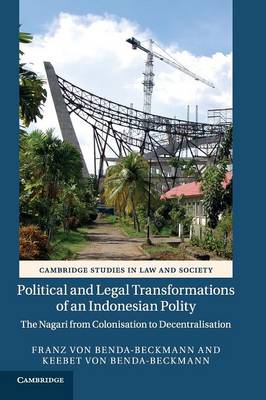
Cambridge Studies in Law and Society: Political and Legal Transformations of an Indonesian Polity: The Nagari from Colonisation to Decentralisation
Product Details:
Format: Paperback / softback
Publisher: Cambridge University Press
Language: English
Dimensions: 23.00 X 3.00 X 15.00
Publisher Code: 9781316618530
Date Added: 2018-08-10
Search Category: International
Jurisdiction: International
Overview:
Political and Legal Transformations of an Indonesian Polity is a long-term study of the historical transformations of the Minangkabau polity of nagari, property relations and the ever-changing dynamic relationships between Minangkabau matrilineal adat law, Islamic law and state law. While the focus is on the period since the fall of President Suharto in 1998, the book charts a long history of political and legal transformations before and after Indonesia's independence, in which the continuities are as notable as the changes. It also throws light on the transnational processes through which legal and political ideas spread and acquire new meanings. The multi-temporal historical approach adopted is also relevant to the more general discussions of the relationship between anthropology and history, the creation of customary law, identity construction, and the anthropology of colonialism.
+ View More
Table Of Contents:
1. Towards an anthropological understanding of political and legal change; 2. The pre-colonial nagari; 3. Minangkabau under colonial government; 4. Japanese occupation, independence and postcolonial transformation until 1983; 5. Centralised government at its zenith; 6. Reformasi: constitutional reforms and regional autonomy; 7. Creating new nagari structures; 8. The return to the nagari: smooth transitions; 9. Uneasy transformations; 10. Governing the village; 11. New dynamics in property rights; 12. Never ending disputes; 13. Property law reconstituted - uncertainty perpetuated; 14. Old issues revisited: adat, Islam and Minangkabau identity politics; 15. Decentralisation, the transformation of the nagari and the dynamics of legal pluralism: some conclusions.