Want a Shipping Estimate? Add an Indian Pin Code, Click Here
This Product
Ships in 3-4 Weeks
Recommend
1
Share
4
Share
2
Share
5
Share
5
Send By e-mail
Verify Phone Number
Please enter the One Time Password (OTP) to verify phone number.
Write your own review
In just a few steps below you can become an online reviewer.
Please click on Continue to submit your review.
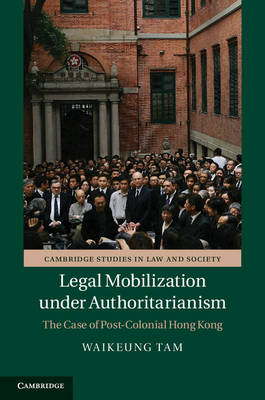
Title: Cambridge Studies in Law and Society: Legal Mobilization under Authoritarianism: The Case of Post-Colonial Hong Kong
Reviewed By:
Write your review here:
NOTE:HTML is not translated!
Rating:
Share this product on email
Cambridge Studies in Law and Society: Legal Mobilization under Authoritarianism: The Case of Post-Colonial Hong Kong
Product Details:
Format: Hardback
Publisher: Cambridge University Press
Language: English
Dimensions: 23.00 X 1.00 X 15.00
Publisher Code: 9781107031999
Date Added: 2018-08-05
Search Category: International
Jurisdiction: International
Overview:
Legal mobilization is the process by which individuals invoke their legal rights and use litigation to defend or develop these rights against the government. In recent years, increasing attention has been paid to this phenomenon as it occurs under authoritarian regimes. It is often suggested that, in such situations, legal mobilization is caused by the strategic interests of the ruling elites. Using the case study of post-colonial Hong Kong, where legal mobilization has by no means unfolded as political authorities would wish, Waikeung Tam casts doubt on this contention. To do so, he examines in depth why and how legal mobilization arises under authoritarianism. Tam analyses quantitative data of changes in the Hong Kong judiciary agendas over the last three decades and uses detailed interviews with activists, politicians, cause lawyers, judges and government officials to reveal the complex underlying socio-political forces at play.
+ View More
Table Of Contents:
1. Introduction: explaining the rise of legal mobilization in post-colonial Hong Kong; 2. The growth of legal mobilization in post-colonial Hong Kong; 3. Critical antecedent - legal complex; 4. The opening of new legal opportunities; 5. The reversal of political opportunities; 6. The political origins of cause lawyering in Hong Kong; 7. Cause lawyers as transformative agents; 8. Rights advocacy groups as transformative agents; 9. The impacts of the judicialization of politics; 10. Conclusion: theoretical and comparative contributions; Appendix 1. Human rights and public policy litigation the Privy Council and the Court of Final Appeal decided (1981-2010); Appendix 2. Important litigation brought by pro-democracy politicians and social activists to the Court of Appeal (CoA) and the Court of First Instance (CFI) (1981-2010); Appendix 3. List of interviewees (alphabetical by category).