Want a Shipping Estimate? Add an Indian Pin Code, Click Here
This Product
Ships in 3-4 Weeks
Recommend
1
Share
1
Share
1
Share
0
Share
1
Send By e-mail
Verify Phone Number
Please enter the One Time Password (OTP) to verify phone number.
Write your own review
In just a few steps below you can become an online reviewer.
Please click on Continue to submit your review.
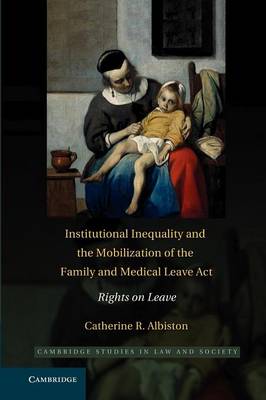
Title: Cambridge Studies in Law and Society: Institutional Inequality and the Mobilization of the Family and Medical Leave Act: Rights on Leave
Reviewed By:
Write your review here:
NOTE:HTML is not translated!
Rating:
Share this product on email
Cambridge Studies in Law and Society: Institutional Inequality and the Mobilization of the Family and Medical Leave Act: Rights on Leave
Product Details:
Format: Paperback / softback
Publisher: Cambridge University Press
Language: English
Dimensions: 23.00 X 2.00 X 15.00
Publisher Code: 9780521703949
Date Added: 2018-08-10
Search Category: International
Jurisdiction: International
Overview:
How do Family and Medical Leave Act rights operate in practice in the courts and in the workplace? This empirical study examines how institutions and social practices transform the meaning of these rights to recreate inequality. Workplace rules and norms built around the family wage ideal, the assumption that disability and work are mutually exclusive, and management's historical control over time all constrain opportunities for social change. Yet workers can also mobilize rights as a cultural discourse to change the social meaning of family and medical leave. Drawing on theoretical frameworks from social constructivism and new institutionalism, this study explains how institutions transform rights to recreate systems of power and inequality but at the same time also provide opportunities for law to change social structure. It provides a fresh look at the perennial debate about law and social change by examining how institutions shape the process of rights mobilization.
+ View More
Table Of Contents:
1. Institutions, inequality, and the mobilization of rights; 2. The social institution of work; 3. Institutional inequality and legal reform; 4. Mobilizing the FMLA in the workplace: rights, institutions, and social meaning; 5. Mobilizing rights in the courts: the paradox of losing by winning; 6. Conclusion.