Want a Shipping Estimate? Add an Indian Pin Code, Click Here
This Product
Ships in 3-4 Weeks
Recommend
1
Share
4
Share
2
Share
5
Share
5
Send By e-mail
Verify Phone Number
Please enter the One Time Password (OTP) to verify phone number.
Write your own review
In just a few steps below you can become an online reviewer.
Please click on Continue to submit your review.
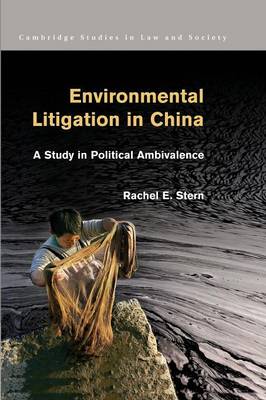
Title: Cambridge Studies in Law and Society: Environmental Litigation in China: A Study in Political Ambivalence
Reviewed By:
Write your review here:
NOTE:HTML is not translated!
Rating:
Share this product on email
Cambridge Studies in Law and Society: Environmental Litigation in China: A Study in Political Ambivalence
Product Details:
Format: Paperback / softback
Publisher: Cambridge University Press
Language: English
Dimensions: 23.00 X 2.00 X 15.00
Publisher Code: 9781107460027
Date Added: 2018-08-10
Search Category: International
Jurisdiction: International
Overview:
This is a book about the improbable: seeking legal relief for pollution in contemporary China. In a country known for tight political control and ineffectual courts, Environmental Litigation in China unravels how everyday justice works: how judges make decisions, why lawyers take cases, and how international influence matters. It is a readable account of how the leadership's mixed signals and political ambivalence play out on the ground - propelling some, such as the village doctor who fought a chemical plant for more than a decade, even as others back away from risk. Yet this remarkable book shows that even in a country where expectations would be that law wouldn't much matter, environmental litigation provides a sliver of space for legal professionals to explore new roles and, in so doing, probe the boundary of what is politically possible.
+ View More
Table Of Contents:
1. Post-Mao: economic growth, environmental protection, and the law; 2. From dispute to decision; 3. Frontiers of environmental law; 4. Political ambivalence: the state; 5. On the front lines: the judges; 6. Heroes or troublemakers? The lawyers; 7. Soft support: the international NGOs; 8. Thinking about outcomes.