Want a Shipping Estimate? Add an Indian Pin Code, Click Here
This Product
Ships in 3-4 Weeks
Recommend
1
Share
4
Share
2
Share
5
Share
5
Send By e-mail
Verify Phone Number
Please enter the One Time Password (OTP) to verify phone number.
Write your own review
In just a few steps below you can become an online reviewer.
Please click on Continue to submit your review.
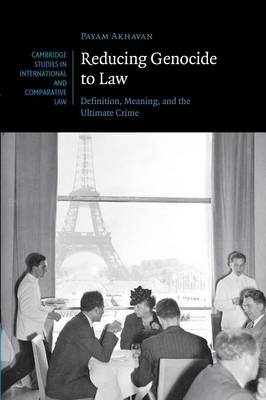
Title: Cambridge Studies in International and Comparative Law: Series Number 87: Reducing Genocide to Law: Definition, Meaning, and the Ultimate Crime
Reviewed By:
Write your review here:
NOTE:HTML is not translated!
Rating:
Share this product on email
Cambridge Studies in International and Comparative Law: Series Number 87: Reducing Genocide to Law: Definition, Meaning, and the Ultimate Crime
Product Details:
Format: Paperback / softback
Publisher: Cambridge University Press
Language: English
Dimensions: 23.00 X 1.00 X 15.00
Publisher Code: 9781107480056
Date Added: 2018-08-10
Search Category: International
Jurisdiction: International
Overview:
Could the prevailing view that genocide is the ultimate crime be wrong? Is it possible that it is actually on an equal footing with war crimes and crimes against humanity? Is the power of the word genocide derived from something other than jurisprudence? And why should a hierarchical abstraction assume such importance in conferring meaning on suffering and injustice? Could reducing a reality that is beyond reason and words into a fixed category undermine the very progress and justice that such labelling purports to achieve? For some, these questions may border on the international law equivalent of blasphemy. This original and daring book, written by a renowned scholar and practitioner who was the first Legal Advisor to the UN Prosecutor at The Hague, is a probing reflection on empathy and our faith in global justice.
+ View More
Table Of Contents:
1. The power of a word; 2. The taxonomy of crimes; 3. The core elements of international crimes; 4. A hierarchy of international crimes?; 5. Naming the nameless crime; 6. Who owns 'genocide'?; 7. Contesting 'genocide' in jurisprudence; 8. Silence, empathy, and the potentialities of jurisprudence.