Want a Shipping Estimate? Add an Indian Pin Code, Click Here
This Product
Ships in 3-4 Weeks
Recommend
1
Share
4
Share
2
Share
5
Share
5
Send By e-mail
Verify Phone Number
Please enter the One Time Password (OTP) to verify phone number.
Write your own review
In just a few steps below you can become an online reviewer.
Please click on Continue to submit your review.
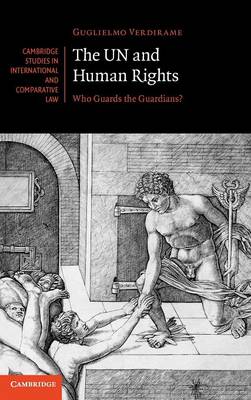
Title: Cambridge Studies in International and Comparative Law: Series Number 82: The UN and Human Rights: Who Guards the Guardians?
Reviewed By:
Write your review here:
NOTE:HTML is not translated!
Rating:
Share this product on email
Cambridge Studies in International and Comparative Law: Series Number 82: The UN and Human Rights: Who Guards the Guardians?
Product Details:
Format: Hardback
Publisher: Cambridge University Press
Language: English
Dimensions: 23.00 X 3.00 X 16.00
Publisher Code: 9780521841900
Date Added: 2018-08-09
Search Category: International
Jurisdiction: International
Overview:
Through an analysis of UN operations including international territorial administration, refugee camps, peacekeeping, the implementation of sanctions and the provision of humanitarian aid, this book shows that the powers exercised by the UN carry a serious risk of human rights abuse. The International Law Commission has codified and developed the law of institutional responsibility, but, while indispensable, these principles and rules cannot on their own ensure compliance and accountability. The 'liberty deficit' of the UN and of other international organisations thus remains an urgent legal and political problem. Some solutions may be available; indeed, recent state and institutional practice offers interesting examples in this respect. But at a fundamental level we need to ask ourselves whether, judged on the basis of the principle of liberty, the power shift from states to international organisations is always beneficial.
+ View More
Table Of Contents:
1. Introduction; 2. Concepts and definitions; 3. Human rights obligations of international organisations; 4. International institutional responsibility; 5. UN relief and development operations; 6. UN peacekeeping; 7. International administrations; 8. Implementation of UN sanctions; 9. Accountability; 10. Conclusions.