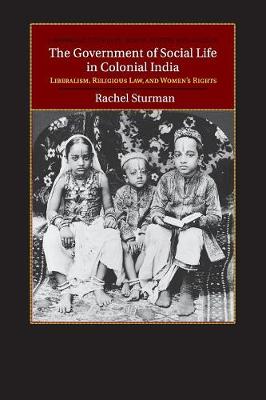
Cambridge Studies in Indian History and Society: Series Number 21: The Government of Social Life in Colonial India: Liberalism, Religious Law, and Women's Rights
Want a Shipping Estimate? Add an Indian Pin Code, Click Here
This Product
Ships in 3-4 Weeks
Recommend
1
Share
4
Share
2
Share
5
Share
5
Send By e-mail
Verify Phone Number
Please enter the One Time Password (OTP) to verify phone number.
Write your own review
In just a few steps below you can become an online reviewer.
Please click on Continue to submit your review.
Title: Cambridge Studies in Indian History and Society: Series Number 21: The Government of Social Life in Colonial India: Liberalism, Religious Law, and Women's Rights
Reviewed By:
Write your review here:
NOTE:HTML is not translated!
Rating:
Share this product on email
Cambridge Studies in Indian History and Society: Series Number 21: The Government of Social Life in Colonial India: Liberalism, Religious Law, and Women's Rights
Product Details:
Format: Paperback / softback
Publisher: Cambridge University Press
Language: English
Dimensions: 23.00 X 1.00 X 15.00
Publisher Code: 9781316649787
Date Added: 2018-08-10
Search Category: International
Jurisdiction: International
Overview:
From the early days of colonial rule in India, the British established a two-tier system of legal administration. Matters deemed secular were subject to British legal norms, while suits relating to the family were adjudicated according to Hindu or Muslim law, known as personal law. This important new study analyses the system of personal law in colonial India through a re-examination of women's rights. Focusing on Hindu law in western India, it challenges existing scholarship, showing how - far from being a system based on traditional values - Hindu law was developed around ideas of liberalism, and that this framework encouraged questions about equality, women's rights, the significance of bodily difference, and more broadly the relationship between state and society. Rich in archival sources, wide-ranging and theoretically informed, this book illuminates how personal law came to function as an organising principle of colonial governance and of nationalist political imaginations.
+ View More
Table Of Contents:
Introduction; Part I. Economic Governance: 1. Property between law and political economy; 2. The dilemmas of social economy; Part II. The Politics of Personal Law: 3. Hindu law as a regime of rights; 4. Custom and human value in the debates on Hindu marriage; 5. Law, community, and belonging; Conclusion.