Want a Shipping Estimate? Add an Indian Pin Code, Click Here
This Product
Ships in 3-4 Weeks
Recommend
1
Share
4
Share
2
Share
5
Share
5
Send By e-mail
Verify Phone Number
Please enter the One Time Password (OTP) to verify phone number.
Write your own review
In just a few steps below you can become an online reviewer.
Please click on Continue to submit your review.
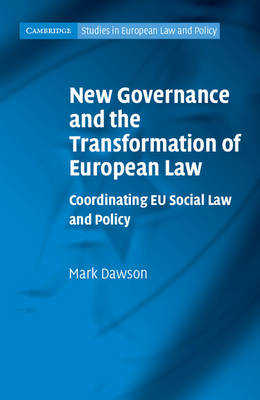
Title: Cambridge Studies in European Law and Policy: New Governance and the Transformation of European Law: Coordinating EU Social Law and Policy
Reviewed By:
Write your review here:
NOTE:HTML is not translated!
Rating:
Share this product on email
Cambridge Studies in European Law and Policy: New Governance and the Transformation of European Law: Coordinating EU Social Law and Policy
Product Details:
Format: Hardback
Publisher: Cambridge University Press
Language: English
Dimensions: 23.00 X 2.00 X 15.00
Publisher Code: 9781107006324
Date Added: 2018-08-09
Search Category: International
Jurisdiction: International
Overview:
The development of non-binding new governance methods has challenged the traditional ideals of EU law by suggesting that soft norms and executive networks may provide a viable alternative. Rather than see law and new governance as oppositional projects, Mark Dawson argues that new governance can be seen as an example of legal 'transformation', in which soft norms and hard law institutions begin to cohabit and interact. He charts this transformation by analysing the Open Method of Coordination (OMC) for Social Inclusion and Protection. While this process illustrates some of the concrete advantages for EU social policy which new governance has brought, it also illustrates their extensive legitimacy challenges. Methods like the OMC have both excluded traditional institutions, such as Courts and Parliaments, and altered the boundaries of domestic constitutional frameworks. The book concludes with some practical suggestions for how a political 'constitutionalisation' of new governance could look.
+ View More
Table Of Contents:
Introduction; 1. The origins of an open method of coordination; 2. Relating governance and law; 3. Governance as proceduralisation; 4. Assessing the procedural paradigm: the case of the OMC SPSI; 5. Constitutionalising new governance; Epilogue.