Want a Shipping Estimate? Add an Indian Pin Code, Click Here
This Product
Ships in 3-4 Weeks
Recommend
1
Share
1
Share
1
Share
0
Share
1
Send By e-mail
Verify Phone Number
Please enter the One Time Password (OTP) to verify phone number.
Write your own review
In just a few steps below you can become an online reviewer.
Please click on Continue to submit your review.
Title: Cambridge Studies in English Legal History: Marriage Law and Practice in the Long Eighteenth Century: A Reassessment
Reviewed By:
Write your review here:
NOTE:HTML is not translated!
Rating:
Share this product on email
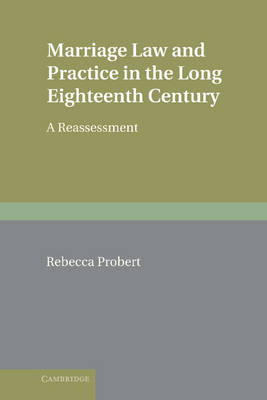
Cambridge Studies in English Legal History: Marriage Law and Practice in the Long Eighteenth Century: A Reassessment
Product Details:
Format: Hardback
Publisher: Cambridge University Press
Language: English
Dimensions: 22.00 X 3.00 X 14.00
Publisher Code: 9780521516150
Date Added: 2018-08-05
Search Category: International
Jurisdiction: International
Overview:
This book uses a wide range of primary sources - legal, literary and demographic - to provide a radical reassessment of eighteenth-century marriage. It disproves the widespread assumption that couples married simply by exchanging consent, demonstrating that such exchanges were regarded merely as contracts to marry and that marriage in church was almost universal outside London. It shows how the Clandestine Marriages Act of 1753 was primarily intended to prevent clergymen operating out of London's Fleet prison from conducting marriages, and that it was successful in so doing. It also refutes the idea that the 1753 Act was harsh or strictly interpreted, illustrating the courts' pragmatic approach. Finally, it establishes that only a few non-Anglicans married according to their own rites before the Act; while afterwards most - save the exempted Quakers and Jews - similarly married in church. In short, eighteenth-century couples complied with whatever the law required for a valid marriage.
+ View More
Table Of Contents:
1. Introduction; 2. The misunderstood contract per verba de praesenti; 3. The myths of 'informal' and 'common law' marriage; 4. The little-considered marriage practices of non-Anglicans; 5. The unacknowledged regularity of clandestine marriages; 6. The eventual passage and actual terms of the 1753 Act; 7. The unappreciated success of the 1753 Act; 8. The unexplored judicial interpretation of the Act; 9. The overlooked response of non-Anglicans; 10. Conclusion.