Want a Shipping Estimate? Add an Indian Pin Code, Click Here
This Product
Ships in 3-4 Weeks
Recommend
1
Share
4
Share
2
Share
5
Share
5
Send By e-mail
Verify Phone Number
Please enter the One Time Password (OTP) to verify phone number.
Write your own review
In just a few steps below you can become an online reviewer.
Please click on Continue to submit your review.
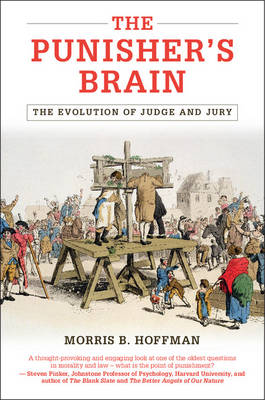
Title: Cambridge Studies in Economics, Choice, and Society: The Punisher's Brain: The Evolution of Judge and Jury
Reviewed By:
Write your review here:
NOTE:HTML is not translated!
Rating:
Share this product on email
Cambridge Studies in Economics, Choice, and Society: The Punisher's Brain: The Evolution of Judge and Jury
Product Details:
Format: Hardback
Publisher: Cambridge University Press
Language: English
Dimensions: 23.00 X 3.00 X 16.00
Publisher Code: 9781107038066
Date Added: 2018-08-10
Search Category: International
Jurisdiction: International
Overview:
Why do we punish, and why do we forgive? Are these learned behaviors, or is there something deeper going on? This book argues that there is indeed something deeper going on, and that our essential response to the killers, rapists, and other wrongdoers among us has been programmed into our brains by evolution. Using evidence and arguments from neuroscience and evolutionary psychology, Morris B. Hoffman traces the development of our innate drives to punish - and to forgive - throughout human history. He describes how, over time, these innate drives became codified into our present legal systems and how the responsibility and authority to punish and forgive was delegated to one person - the judge - or a subset of the group - the jury. Hoffman shows how these urges inform our most deeply held legal principles and how they might animate some legal reforms.
+ View More
Table Of Contents:
Introduction; 1. The most original of original sins; 2. Detecting and blaming; 3. First-party punishment: conscience and guilt; 4. Second-party punishment: retaliation and revenge; 5. Third-party punishment: retribution; 6. Forgiveness and its signals; 7. Delegating punishment; 8. Legal dissonances; 9. Evaluating some process dissonances; 10. Into the gap: evaluating some substantive dissonances; 11. Brains punishing brains.