Want a Shipping Estimate? Add an Indian Pin Code, Click Here
This Product
Ships in 3-4 Weeks
Recommend
1
Share
4
Share
2
Share
5
Share
5
Send By e-mail
Verify Phone Number
Please enter the One Time Password (OTP) to verify phone number.
Write your own review
In just a few steps below you can become an online reviewer.
Please click on Continue to submit your review.
Title: Cambridge Studies in Constitutional Law: Series Number 3: Judging Social Rights
Reviewed By:
Write your review here:
NOTE:HTML is not translated!
Rating:
Share this product on email
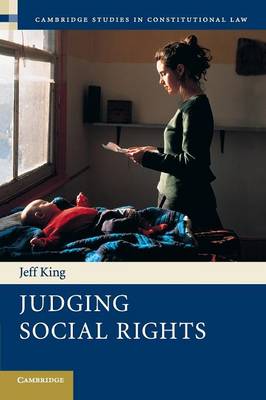
Cambridge Studies in Constitutional Law: Series Number 3: Judging Social Rights
Product Details:
Format: Paperback / softback
Publisher: Cambridge University Press
Language: English
Dimensions: 23.00 X 2.00 X 15.00
Publisher Code: 9781107400320
Date Added: 2018-08-10
Search Category: International
Jurisdiction: International
Overview:
Countries that now contemplate constitutional reform often grapple with the question of whether to constitutionalise social rights. This book presents an argument for why, under the right conditions, doing so can be a good way to advance social justice. In making such a case, the author considers the nature of the social minimum, the role of courts among other institutions, the empirical record of judicial impact, and the role of constitutional text. He argues, however, that when enforcing such rights, judges ought to adopt a theory of judicial restraint structured around four principles: democratic legitimacy, polycentricity, expertise and flexibility. These four principles, when taken collectively, commend an incrementalist approach to adjudication. The book combines theoretical, doctrinal, empirical and comparative analysis, and is written to be accessible to lawyers, social scientists, political theorists and human rights advocates.
+ View More
Table Of Contents:
1. Aims and methods; Part I. The Case for Constitutional Social Rights: 2. The case for social rights; 3. The value of courts in light of the alternatives; 4. A basic interpretive approach; Part II. A Theory of Judicial Restraint: 5. Institutional approaches to judicial restraint; 6. Democratic legitimacy; 7. Polycentricity; 8. Expertise; 9. Flexibility; Part III. Incrementalism: 10. Incrementalism as a general theme.