Want a Shipping Estimate? Add an Indian Pin Code, Click Here
This Product
Ships in 3-4 Weeks
Recommend
1
Share
4
Share
2
Share
5
Share
5
Send By e-mail
Verify Phone Number
Please enter the One Time Password (OTP) to verify phone number.
Write your own review
In just a few steps below you can become an online reviewer.
Please click on Continue to submit your review.
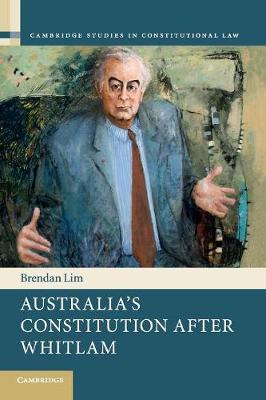
Title: Cambridge Studies in Constitutional Law: Series Number 17: Australia's Constitution after Whitlam
Reviewed By:
Write your review here:
NOTE:HTML is not translated!
Rating:
Share this product on email
Cambridge Studies in Constitutional Law: Series Number 17: Australia's Constitution after Whitlam
Product Details:
Format: Paperback / softback
Publisher: Cambridge University Press
Language: English
Dimensions: 23.00 X 2.00 X 15.00
Publisher Code: 9781107551992
Date Added: 2018-08-10
Search Category: International
Jurisdiction: International
Overview:
Australia's constitutional crisis of 1975 was not simply about the precise powers of the Senate or the Governor-General. It was about competing accounts of how to legitimate informal constitutional change. For Prime Minister Gough Whitlam, and the parliamentary tradition that he invoked, national elections sufficiently legitimated even the most constitutionally transformative of his goals. For his opponents, and a more complex tradition of popular sovereignty, more decisive evidence was required of the consent of the people themselves. This book traces the emergence of this fundamental constitutional debate and chronicles its subsequent iterations in sometimes surprising institutional configurations: the politics of judicial appointment in the Murphy Affair; the evolution of judicial review in the Mason Court; and the difficulties Australian republicanism faced in the Howard Referendum. Though the patterns of institutional engagement have varied, the persistent question of how to legitimate informal constitutional change continues to shape Australia's constitution after Whitlam.
+ View More
Table Of Contents:
Part 1. Introduction: I. New questions; II. The plan; Part 2. Informal Constitutional Change: I. The possibility of informal change; II. The identification of informal change; III. The legitimacy of informal change; Part 3. The Whitlam Dismissal: I. The standard narrative; II. The dismissal and the constitutional canon; III. The higher law narrative; IV. Conclusion; Part 4. The Murphy Affair: I. Events of 1975-86; II. Murphy and the standard narrative; III. Murphy and the higher law narrative; IV. Conclusion; Part 5. The Mason Court: I. Internal point of view; II. Dixon's orthodoxy; III. Popular sovereignty foreshadowed: 1962-86; IV. Popular sovereignty ascendant: 1987-95; V. Parliamentary supremacy returns: 1996-; VI. Conclusion; Part 6. The Howard Referendum: I. Constitutional law and identity; II. Whitlam and Republicanism; III. Republicanism reinvented; IV. Clash of grammars; V. Conclusion; Part 7. Conclusion.