Want a Shipping Estimate? Add an Indian Pin Code, Click Here
This Product
Ships in 3-4 Weeks
Recommend
1
Share
4
Share
2
Share
5
Share
5
Send By e-mail
Verify Phone Number
Please enter the One Time Password (OTP) to verify phone number.
Write your own review
In just a few steps below you can become an online reviewer.
Please click on Continue to submit your review.
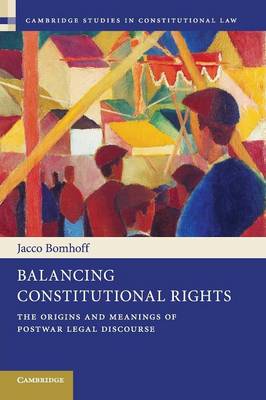
Title: Cambridge Studies in Constitutional Law: Series Number 10: Balancing Constitutional Rights: The Origins and Meanings of Postwar Legal Discourse
Reviewed By:
Write your review here:
NOTE:HTML is not translated!
Rating:
Share this product on email
Cambridge Studies in Constitutional Law: Series Number 10: Balancing Constitutional Rights: The Origins and Meanings of Postwar Legal Discourse
Product Details:
Format: Paperback / softback
Publisher: Cambridge University Press
Language: English
Dimensions: 23.00 X 1.00 X 15.00
Publisher Code: 9781107622487
Date Added: 2018-08-10
Search Category: International
Jurisdiction: International
Overview:
The language of balancing is pervasive in constitutional rights jurisprudence around the world. In this book, Jacco Bomhoff offers a comparative and historical account of the origins and meanings of this talismanic form of language, and of the legal discourse to which it is central. Contemporary discussion has tended to see the increasing use of balancing as the manifestation of a globalization of constitutional law. This book is the first to argue that 'balancing' has always meant radically different things in different settings. Bomhoff uses detailed case studies of early post-war US and German constitutional jurisprudence to show that the same unique language expresses both biting scepticism and profound faith in law and adjudication, and both deep pessimism and high aspirations for constitutional rights. An understanding of these radically different meanings is essential for any evaluation of the work of constitutional courts today.
+ View More
Table Of Contents:
Introduction; 1. Questioning a 'global age of balancing'; 2. Balancing's beginnings: concepts and interests; 3. 'A perfect constitutional order'; 4. 'A dangerous doctrine'; 5. Two paradigms of balancing; Conclusion.