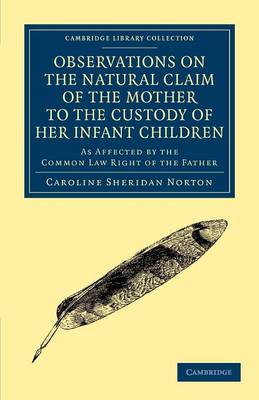
Cambridge Library Collection - British and Irish History, 19th Century: Observations on the Natural Claim of the Mother to the Custody of her Infant Children: As Affected by the Common Law Right of the Father
Want a Shipping Estimate? Add an Indian Pin Code, Click Here
This Product
Ships in 3-4 Weeks
Recommend
1
Share
1
Share
1
Share
0
Share
1
Send By e-mail
Verify Phone Number
Please enter the One Time Password (OTP) to verify phone number.
Write your own review
In just a few steps below you can become an online reviewer.
Please click on Continue to submit your review.
Title: Cambridge Library Collection - British and Irish History, 19th Century: Observations on the Natural Claim of the Mother to the Custody of her Infant Children: As Affected by the Common Law Right of the Father
Reviewed By:
Write your review here:
NOTE:HTML is not translated!
Rating:
Share this product on email
Cambridge Library Collection - British and Irish History, 19th Century: Observations on the Natural Claim of the Mother to the Custody of her Infant Children: As Affected by the Common Law Right of the Father
Product Details:
Format: Paperback / softback
Publisher: Cambridge University Press
Language: English
Dimensions: 22.00 X 1.00 X 14.00
Publisher Code: 9781108040341
Date Added: 2018-08-10
Search Category: International
Jurisdiction: International
Overview:
Caroline Norton (1808-77), author and law reform campaigner, was the granddaughter of the playwright Sheridan and soprano Elizabeth Linley. Her disastrous, violent marriage in 1827 to the financially irresponsible Tory MP and barrister George Norton led her to seek escape in writing poetry. Anonymous autobiographical novels followed, exploring women's powerlessness in marriage, together with regular contributions to periodicals such as Macmillan's Magazine. Flamboyant, intelligent and temperamental, she secured her place in literary society, numbering Disraeli and Dickens among her friends. Ever jealous, her husband accused her of adultery with Lord Melbourne, but the case was unproven. In revenge, he refused his wife access to their sons, and it was this act which led to her determined campaign to improve the rights of women in marriage and divorce. This work, first published anonymously in 1837, was instrumental in the subsequent passing of the Custody of Infants Act (1839).