Want a Shipping Estimate? Add an Indian Pin Code, Click Here
This Product
Ships in 3-4 Weeks
Recommend
1
Share
4
Share
2
Share
5
Share
5
Send By e-mail
Verify Phone Number
Please enter the One Time Password (OTP) to verify phone number.
Write your own review
In just a few steps below you can become an online reviewer.
Please click on Continue to submit your review.
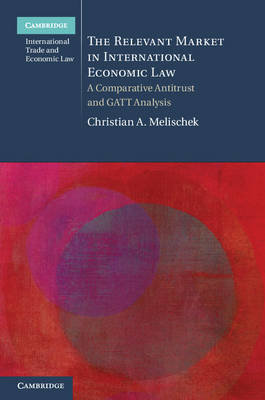
Title: Cambridge International Trade and Economic Law: The Relevant Market in International Economic Law: A Comparative Antitrust and GATT Analysis
Reviewed By:
Write your review here:
NOTE:HTML is not translated!
Rating:
Share this product on email
Cambridge International Trade and Economic Law: The Relevant Market in International Economic Law: A Comparative Antitrust and GATT Analysis
Product Details:
Format: Hardback
Publisher: Cambridge University Press
Language: English
Dimensions: 23.00 X 3.00 X 15.00
Publisher Code: 9781107031524
Date Added: 2018-08-05
Search Category: International
Jurisdiction: International
Overview:
This book provides what international trade law has hitherto lacked: a coherent analysis of 'product likeness' under Article III of the GATT. Christian A. Melischek develops an economic approach to the interpretation of 'like' products on the basis of a comparative analysis with antitrust theories on market definition. Not only does he propose a specific substantive economic test to render the notion of product likeness operational, but he also examines the institutional and procedural frameworks for expert economic evidence necessary to implement an economic approach to the interpretation of product likeness. On a methodological level, the book adds a new interdisciplinary dimension to the legal debate by exploring the use of quantitative and econometric methods for the implementation of the proposed economic test.
+ View More
Table Of Contents:
Introduction; 1. The research question and scope of the study; 2. Practical relevance of the research question; 3. Methodology and structure; Part I. Comparison of Antitrust and International Trade Law: 4. Emphasizing differences or commonalities?; 5. Antitrust law; 6. WTO/GATT law; 7. Congruence in efficiency and welfare standards; Part II. The Role of Market Definition: 8. Antitrust law; 9. Article III of the GATT; 10. Conclusion; Part III. Analytical Evolution from the Traditional to the Economic Approach: 11. The traditional formalistic approach; 12. The economic approach; 13. Assessment of the analytical evolution; 14. Conclusion; Part IV. Conceptualizing an Economic Approach to Market Definition: 15. Introduction; 16. Market definition framework: a matter of treaty interpretation; 17. The content of a marketplace-test; 18. Potential competition; 19. The relevant 'market' concept; 20. The role of the traditional criteria; 21. Making sense of the different Article III prohibitions; 22. Conclusion; Part V. The Implementation of an Economic Approach: Quantitative Methods: 23. Introduction; 24. The law and economics of expert economic testimony; 25. Analysis of price elasticities of demand.