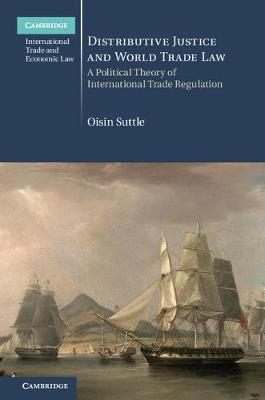
Cambridge International Trade and Economic Law: Series Number 36: Distributive Justice and World Trade Law: A Political Theory of International Trade Regulation
Want a Shipping Estimate? Add an Indian Pin Code, Click Here
This Product
Ships in 3-4 Weeks
Recommend
1
Share
4
Share
2
Share
5
Share
5
Send By e-mail
Verify Phone Number
Please enter the One Time Password (OTP) to verify phone number.
Write your own review
In just a few steps below you can become an online reviewer.
Please click on Continue to submit your review.
Title: Cambridge International Trade and Economic Law: Series Number 36: Distributive Justice and World Trade Law: A Political Theory of International Trade Regulation
Reviewed By:
Write your review here:
NOTE:HTML is not translated!
Rating:
Share this product on email
Cambridge International Trade and Economic Law: Series Number 36: Distributive Justice and World Trade Law: A Political Theory of International Trade Regulation
Product Details:
Format: Hardback
Publisher: Cambridge University Press
Language: English
Dimensions: 23.00 X 3.00 X 16.00
Publisher Code: 9781108415811
Date Added: 2018-08-10
Search Category: International
Jurisdiction: International
Overview:
What does justice demand in international trade regulation? And how far does World Trade Organization (WTO) law respond to those demands? Whether our focus is developing countries, struggling industries, or environmental protection, distributive conflict is a pervasive feature of international economic law. Despite this, we lack an adequate theory of distributive justice for this domain. Drawing on philosophical approaches to global justice, this book advances a novel theory of justice in trade regulation, and applies this to explain and critique the law of the WTO. Integrating theoretical and doctrinal approaches, it demonstrates the potential for political theory to illuminate and inform the progressive development of WTO law, including rules on border measures, discrimination, trade remedies and domestic regulation. Written from an interdisciplinary perspective, accessible to lawyers, philosophers and political scientists, the book will appeal both to theorists interested in building bridges from theory to practice, and practitioners seeking new perspectives on existing problems.
+ View More
Table Of Contents:
Part I. Foundations: 1. Introduction; 2. Why World Trade Law needs a theory of justice; Part II. Justice: 3. Towards a political theory of international economic law; 4. Sovereignty, nationality and the limits of statism; 5. Self-determination and external trade measures; Part III. Law: 6. Border measures, discrimination, and ETMs; 7. Justifying ETMs: development provisions and general exceptions; 8. Trade remedies and fairness in international trade regulation; 9. Domestic regulation, self-determination and DEMs; Part IV. Progress: 10. Conclusion: where to from here?