Want a Shipping Estimate? Add an Indian Pin Code, Click Here
This Product
Ships in 3-4 Weeks
Recommend
1
Share
4
Share
2
Share
5
Share
5
Send By e-mail
Verify Phone Number
Please enter the One Time Password (OTP) to verify phone number.
Write your own review
In just a few steps below you can become an online reviewer.
Please click on Continue to submit your review.
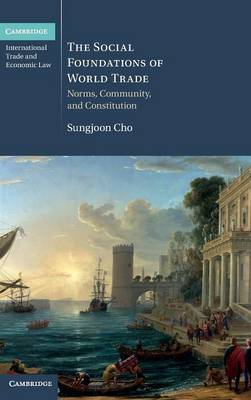
Title: Cambridge International Trade and Economic Law: Series Number 17: The Social Foundations of World Trade: Norms, Community, and Constitution
Reviewed By:
Write your review here:
NOTE:HTML is not translated!
Rating:
Share this product on email
Cambridge International Trade and Economic Law: Series Number 17: The Social Foundations of World Trade: Norms, Community, and Constitution
Product Details:
Format: Hardback
Publisher: Cambridge University Press
Language: English
Dimensions: 23.00 X 2.00 X 16.00
Publisher Code: 9781107036611
Date Added: 2018-08-10
Search Category: International
Jurisdiction: International
Overview:
As highlighted by Pascal Lamy, the former head of the WTO, world trade traditionally involves state-to-state contracts and is based on an anachronistic 'monolocation' production/trade model. It therefore struggles to handle new patterns of trade such as global value chains, which are based on a 'multilocation' model. Although it continues to provide world trade on a general level with a powerful heuristic, the traditional 'rationalist' approach inevitably leaves certain descriptive and normative blind spots. Descriptively, it fails to explain important ideational factors, such as culture and norms, which can effectively guide the behaviour of trading nations with or without material factors such as interests and utilities. Normatively, the innate positivism of the traditional model makes it oblivious to the moral imperatives of the current world trading system, such as development. This book emphatically redresses these blind spots by reconstructing the WTO as a world trade community from a social perspective.
+ View More
Table Of Contents:
1. Introduction: reconstructing the world trading system; 2. Two frameworks on an international organization; 3. The world trade community; 4. Norms and discourse: the internal operation of the world trade community; 5. The world trade constitution: external relationships of the world trade community; 6. Evaluation: the legitimacy of the world trade community; 7. Conclusion: building the world trade community.