Want a Shipping Estimate? Add an Indian Pin Code, Click Here
This Product
Ships in 3-4 Weeks
Recommend
1
Share
1
Share
1
Share
0
Share
1
Send By e-mail
Verify Phone Number
Please enter the One Time Password (OTP) to verify phone number.
Write your own review
In just a few steps below you can become an online reviewer.
Please click on Continue to submit your review.
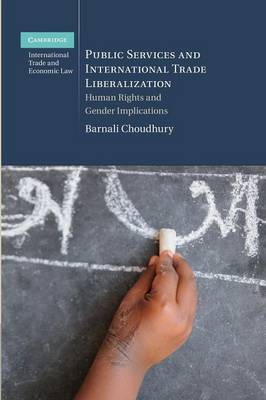
Title: Cambridge International Trade and Economic Law: Public Services and International Trade Liberalization: Human Rights and Gender Implications
Reviewed By:
Write your review here:
NOTE:HTML is not translated!
Rating:
Share this product on email
Cambridge International Trade and Economic Law: Public Services and International Trade Liberalization: Human Rights and Gender Implications
Product Details:
Format: Paperback / softback
Publisher: Cambridge University Press
Language: English
Dimensions: 23.00 X 2.00 X 15.00
Publisher Code: 9781107471177
Date Added: 2018-08-10
Search Category: International
Jurisdiction: International
Overview:
Does public service liberalization pose a threat to gender and human rights? Traditionally considered essential services provided by a state to its citizens, public services are often viewed as public goods which embody social values. Subjecting them to market ideology thus raises concerns that the intrinsic social nature of these services will be negated. Moreover, as those most likely to be reliant on public services, public service liberalization may also further marginalize women. Nevertheless, states continue to increasingly liberalize public services. Barnali Choudhury explores the implications of public service liberalization. Using primarily a legal approach, but drawing from case studies, empirical research and gender theories, she examines whether liberalization under the General Agreement on Trade in Services and other liberalization vehicles such as preferential trade and investment agreements compromise human rights and gender objectives.
+ View More
Table Of Contents:
Introduction; Part I. Foundations: 1. International economic law and human rights; 2. Public services; 3. Instruments for liberalizing public services; Part II. Human Rights and Gendered Implications of Liberalization of Public Services: 4. Liberalization of water services; 5. Liberalization of educational services; 6. Liberalization of health services; 7. Accounting for the differential implications of liberalized public services on developing countries and women; Part III. The Future of Liberalization of Public Services: 8. Should public services continue to be liberalized?; 9. Conclusion; Index.