Want a Shipping Estimate? Add an Indian Pin Code, Click Here
This Product
Ships in 3-4 Weeks
Recommend
1
Share
1
Share
1
Share
0
Share
1
Send By e-mail
Verify Phone Number
Please enter the One Time Password (OTP) to verify phone number.
Write your own review
In just a few steps below you can become an online reviewer.
Please click on Continue to submit your review.
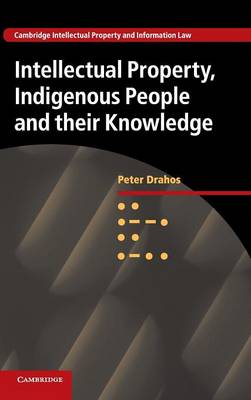
Title: Cambridge Intellectual Property and Information Law: Series Number 25: Intellectual Property, Indigenous People and their Knowledge
Reviewed By:
Write your review here:
NOTE:HTML is not translated!
Rating:
Share this product on email
Cambridge Intellectual Property and Information Law: Series Number 25: Intellectual Property, Indigenous People and their Knowledge
Product Details:
Format: Hardback
Publisher: Cambridge University Press
Language: English
Dimensions: 23.00 X 2.00 X 15.00
Publisher Code: 9781107055339
Date Added: 2018-08-10
Search Category: International
Jurisdiction: International
Overview:
After colonization, indigenous people faced an extractive property rights regime for both their land and knowledge. This book outlines that regime, and how the symbolic function of international intellectual property continues today to assist states to enclose indigenous peoples' knowledge. Drawing on more than 200 interviews, Peter Drahos examines the response of indigenous people to the colonizer's non-developmental property rights. The case studies reveal how they have adapted to the state's extractive order through a process of regulatory bricolage. In order to create a new developmental future for themselves, indigenous developmental networks have been forged - high trust networks that include partnerships with science. Intellectual Property, Indigenous People and their Knowledge argues for a developmental intellectual property order for indigenous people based on a combination of simple rules, principles and a process of regulatory convening.
+ View More
Table Of Contents:
1. The non-developmental state; 2. Cosmology's country; 3. Loss; 4. Symbolic recognition; 5. Rules and the recognition of ancestors; 6. The Kimberley: big projects, little projects; 7. Secret plants; 8. Paying peanuts for biodiversity; 9. Gentle on country, gentle on people; 10. Protecting country's cosmology; 11. Trust in networks.