Want a Shipping Estimate? Add an Indian Pin Code, Click Here
This Product
Ships in 3-4 Weeks
Recommend
1
Share
4
Share
2
Share
5
Share
5
Send By e-mail
Verify Phone Number
Please enter the One Time Password (OTP) to verify phone number.
Write your own review
In just a few steps below you can become an online reviewer.
Please click on Continue to submit your review.
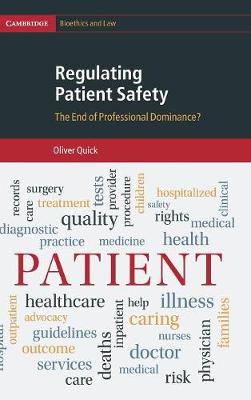
Title: Cambridge Bioethics and Law: Series Number 35: Regulating Patient Safety: The End of Professional Dominance?
Reviewed By:
Write your review here:
NOTE:HTML is not translated!
Rating:
Share this product on email
Cambridge Bioethics and Law: Series Number 35: Regulating Patient Safety: The End of Professional Dominance?
Product Details:
Format: Hardback
Publisher: Cambridge University Press
Language: English
Dimensions: 23.00 X 2.00 X 16.00
Publisher Code: 9780521190992
Date Added: 2018-08-10
Search Category: International
Jurisdiction: International
Overview:
Systematically improving patient safety is of the utmost importance, but it is also an extremely complex and challenging task. This illuminating study evaluates the role of professionalism, regulation and law in seeking to improve safety, arguing that the 'medical dominance' model is ill-suited to this aim, which instead requires a patient-centred vision of professionalism. It brings together literatures on professions, regulation and trust, while examining the different legal mechanisms for responding to patient safety events. Oliver Quick includes an examination in areas of law which have received little attention in this context, such as health and safety law, and coronial law, and contends in particular that the active involvement of patients in their own treatment is fundamental to ensuring their safety.
+ View More
Table Of Contents:
Introduction; 1. The rise and fall of professional dominance; 2. The problem of patient safety; 3. Regulation and trust; 4. Professional regulation and patient safety; 5. Complaining and claiming; 6. The criminalisation of medical harm; 7. Coronial investigations and inquests; 8. Professional responsibility: speaking up and saying sorry; 9. Patients, carers and safety. Conclusion.