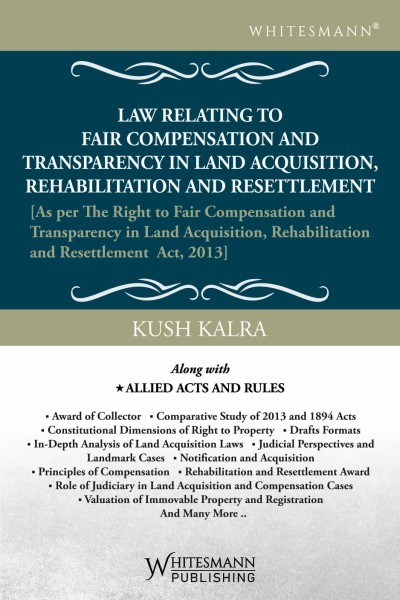
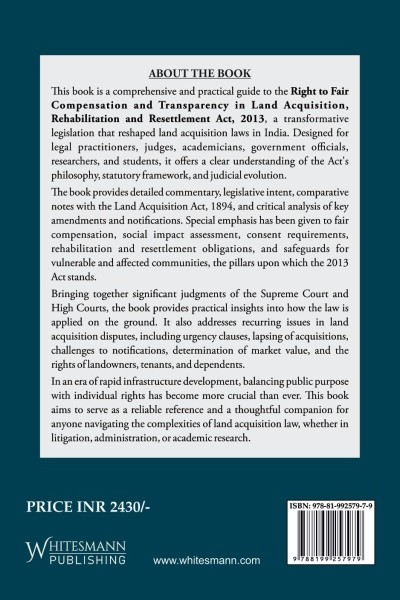
Law Relating to Fair Compensation and Transparency in Land Acquisition, Rehabilitation and Resettlement provides a structured and practical exposition of the 2013 legislation that overhauled India's land acquisition regime. The book explains the philosophy, framework, and functioning of the Act, supported by commentary on statutory provisions, legislative intent, and comparative references to the 1894 Act. It highlights the core pillars of fair compensation, social impact assessment, consent requirements, and rehabilitation and resettlement safeguards. Incorporating major judicial pronouncements and practical interpretations, the work serves as an essential resource for understanding how the law is applied in real-world acquisition scenarios.
Key Features:
- Covers The Right to Fair Compensation and Transparency in Land Acquisition, Rehabilitation and Resettlement Act, 2013 in a detailed and practice-oriented manner.
- Includes allied Acts, rules, notifications, and circulars relevant to land acquisition, compensation, and rehabilitation.
- Provides a comparative study of the 2013 Act and the Land Acquisition Act, 1894, outlining key differences and transitional issues.
- Offers draft formats, procedural checklists, and practical guidance for handling acquisition processes before authorities.
- Examines the Award of the Collector, principles of compensation, valuation of immovable property, and market value determination.
- Discusses the role of the judiciary, including landmark Supreme Court and High Court judgments shaping acquisition law.
- Analyses constitutional dimensions of the right to property and its evolving interpretation in acquisition and compensation cases.
- Addresses complex issues such as urgency clauses, lapsing of acquisition, social impact assessment, rehabilitation obligations, and consent requirements.
- Includes detailed chapters on rehabilitation and resettlement awards, rights of affected families, tenants, and dependents.
This book is ideal for legal practitioners, judges, academicians, government authorities, law students, researchers, and professionals involved in land acquisition, infrastructure development, real estate, and public administration.


 Home > LAW BOOKS > Property and Land Laws > Tenancy and Land Laws



 5
5



![The Practical Lawyer - PLW [Annual Subscription]](https://s3.amazonaws.com/ebcwebstore/images/the-practical-lawyer-magazine-annual-subscription.png)