Want a Shipping Estimate? Add an Indian Pin Code, Click Here
This Product
Ships in 3-4 Weeks
Recommend
1
Share
1
Share
1
Share
0
Share
1
Send By e-mail
Verify Phone Number
Please enter the One Time Password (OTP) to verify phone number.
Write your own review
In just a few steps below you can become an online reviewer.
Please click on Continue to submit your review.
Title: The Main Institutions of Roman Private Law
Reviewed By:
Write your review here:
NOTE:HTML is not translated!
Rating:
Share this product on email
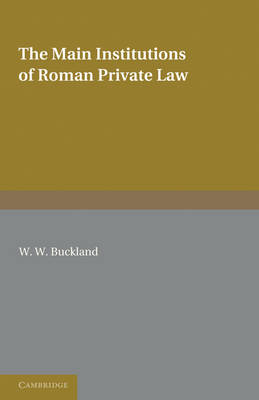
The Main Institutions of Roman Private Law
Product Details:
Format: Paperback / softback
Publisher: Cambridge University Press
Language: English
Dimensions: 22.00 X 3.00 X 14.00
Publisher Code: 9781107680418
Date Added: 2018-08-06
Search Category: International
Jurisdiction: International
Overview:
This 1931 book was written to replace The Elementary Principles of Roman Law, but it is not a second edition of that book. It is more systematic in plan: it aims at giving a central view of the different institutions of the Private Law and of the notions which underlie them. But its purpose is the same: its is for the use of students who have read the Institutes and little more, and it is intended to stimulate rather than to inform. It will still be of interest today.
+ View More
Table Of Contents:
Preface; 1. Sources of law; 2. The chief surviving sources independent of Justinian; 3. Persons; 4. Persons (cont.). The Family; 5. Persons (cont.). The Family (cont.); 6. Res. Property. Possession; 7. Acquisition of ownership; 8. Iura; 9. Representation in acquisition and alienation; 10. Acquisition per universitatem; 11. Acquisition per universitatem (cont.), intestacy, Bonorum Possessio; 12. Legacy and Fideicommissum. Family settlements; 13. Obligations; 14. Obligations (cont.). Contract; 15. Obligations (cont.). Quasi-contract; 16. Obligations (cont.). Incidental rules of Oligatio; 17. The law of security; 18. Obligations (cont.). Delict; 19. Litigation. Legis Actio. Real actions under the Formula; 20. Litigation (cont.). The Cognitio of later law.