EBC Webstore
Eastern Book Company

|
|||
|
|||
 Home > LAW BOOKS > Taxation Laws > Goods and Service Tax > Home > LAW BOOKS > Taxation Laws > Goods and Service Tax > |






 118
118

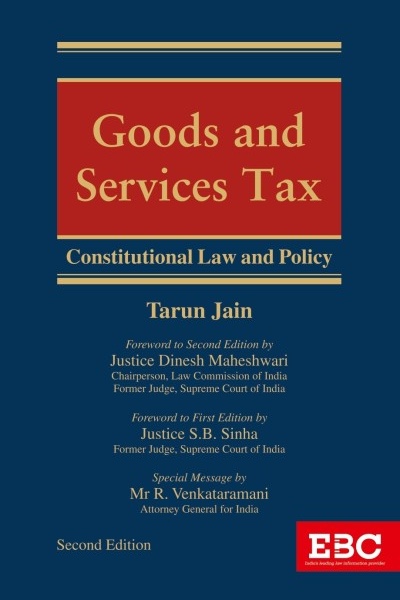
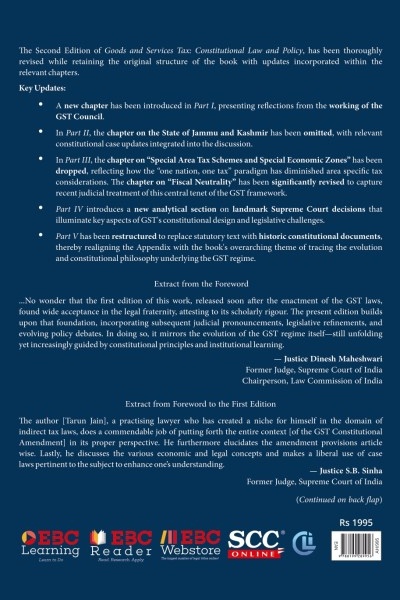
The book is divided into four sections and explains the constitutional law and policy behind GST in a clear and structured manner. It traces the evolution of the constitutional amendment and the policy journey that led to the introduction of GST. The core portion provides a provision-wise analysis of the Constitution Amendment Act, covering policy background, the 2011 and 2014 Amendment Bills, parliamentary debates, and developments after enactment. The book also explains the key legal and economic concepts forming the foundation of GST, making it a valuable guide for understanding the constitutional framework of GST.
Key Features:
This book is intended for indirect tax and GST practitioners, judges, law students, academicians, policy researchers, and chartered accountants seeking a clear and authoritative understanding of the subject.
Extract from the Foreword
The present edition builds upon that foundation, incorporating subsequent judicial pronouncements, legislative refinements, and evolving policy debates. In doing so, it mirrors the evolution of the GST regime itself-still unfolding yet increasingly guided by constitutional principles and institutional learning.
- Justice Dinesh Maheshwari
Former Judge, Supreme Court of India
Chairperson, Law Commission of India
Review
Many lawyers, leave alone laymen, will find it difficult to analyse and absorb the contours of GST, which has revolutionised the tax regime in this country. This book, which analyses in detail the constitutional amendments carried out for implementing GST and also provides an international perspective on GST, will be a useful tool in the hands of legal practitioners and academicians who will help steer the legal discourse on GST.
- K.K. Venugopal
Senior Advocate and Former Attorney General for India
Brief Contents
Dedication
Foreword to the Second Edition - Justice Dinesh Maheshwari
Foreword to the First Edition - Justice S.B. Sinha
Special Message - R. Venkatramani
Preface to the Second Edition
Preface to the First Edition
About the Author
Glossary
Table of Cases
Part I: Introductory
1. Introduction
2. GST Council: The Cornerstone and Pivot of GST
Part II: Constitution (101st Amendment) Act, 2016
3. Constitution Amendments Generally and Validity of Constitution Amendment Act
4. Section 1: Short Title and Commencement
5. Section 2: Insertion of New Article 246-A - Special Provisions with Respect to Goods and Services Tax
6. Section 3: Amendment of Article 248
7. Section 4: Amendment of Article 249
8. Section 5: Amendment of Article 250
9. Section 6: Amendment of Article 268
10. Section 7: Omission of Article 268-A
11. Section 8: Amendment of Article 269
12. Section 9: Insertion of New Article 269-A - Levy and Collection of GST in Inter-State Trade or Commerce
13. Section 10: Amendment of Article 270
14. Section 11: Amendment of Article 271
15. Section 12: Insertion of New Article 279-A - Goods and Services Tax Council
16. Section 13: Amendment of Article 286
17. Section 14: Amendment of Article 366
18. Section 15: Amendment of Article 368
19. Section 16: Amendment of Sixth Schedule
20. Section 17: Amendment of Seventh Schedule
21. Section 18: Compensation to States for Loss of Revenue
22. Section 19: Transitional Provisions
23. Section 20: Power of President to Remove Difficulties
24. Additional Tax on Supply of Goods
25. GST Dispute Settlement Mechanism
26. Notifications Issued under the Constitution Amendment Act
Part III: Salient Features and Conceptual Foundations of GST
27. Value Added Tax
28. Tax on Supply
29. Consumption Tax
30. Destination-Based Tax
31. Fiscal Neutrality (Input Tax Credit)
32. Dual Levy
33. Cooperative Federalism
34. Integrated Goods and Services Tax
35. GST: A Replacement of All Indirect Taxes
36. GST Rate Structure
37. Supply of Immovable Property
Part IV: Analysis of Leading Decisions
38. Mohit Minerals–I: Upholding Constitutional Validity and Legislative Competence
39. Skill Lotto: Constitutional Ambit of GST
40. VKC Footsteps: GST as a Value Added Tax
41. Mohit Minerals–II: Position of GST Council in the Constitutional Framework
42. Tirumala Construction: Importance of Transitional Provisions
Part V: Appendix
1. Constitution (One Hundred and Fifteenth Amendment) Bill, 2011
2. Constitution (One Hundred and Twenty-second Amendment) Bill, 2014
3. Constitution (One Hundred and First Amendment) Act, 2016
4. Notifications Issued under the Constitution (One Hundred and First Amendment) Act, 2016
5. First Discussion Paper on Goods and Services Tax in India
6. Comments of the Department of Revenue on the First Discussion Paper on GST
7. Report of the Task Force on Goods and Services Tax
8. Excerpts from Thirteenth Finance Commission Report
9. Excerpts from 73rd Parliamentary Standing Committee on Finance Report
10. Excerpts from Fourteenth Finance Commission Report
11. Report of the Rajya Sabha Select Committee
Subject Index



|

Click on TITLE to choose available options.
|
|
Click on TITLE to choose available options.
|

|
Click on TITLE to choose available options.
|

|
Click on TITLE to choose available options.
|

|
Click on TITLE to choose available options.
|
|
Click on TITLE to choose available options.
|

|
|

|
Click on TITLE to choose available options.
|
|
Click on TITLE to choose available options.
|
|
||
|
||
|