EBC Webstore
Eastern Book Company

|
|||
|
|||
 Home > LAW BOOKS > Constitutional Law > Constitution of India > Home > LAW BOOKS > Constitutional Law > Constitution of India > |




 9
9

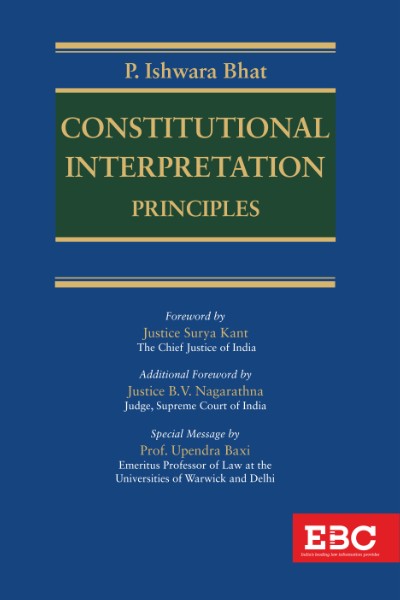
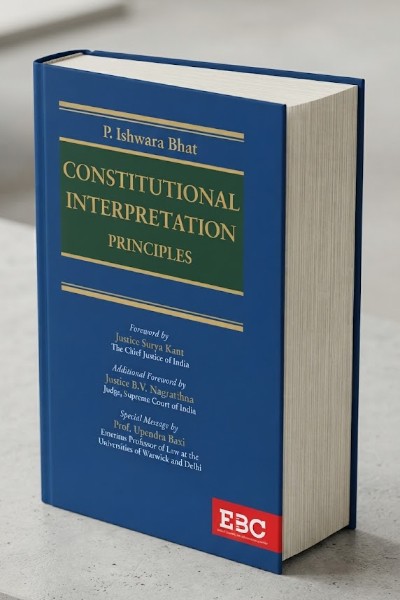
This book is a valuable treatise on the subject, which provides a comprehensive insight into all the principles of constitutional interpretation. With special reference to India. It systematically presents the doctrines, theories, and principles developed by the judiciary for interpreting the Constitution, supported by leading case law, academic views, and comparative constitutional perspectives.
The work examines internal and external aids to interpretation, text-based, structural, and value-based approaches, and the expanding toolkit of constitutional interpretation in light of transformative constitutionalism. It identifies and analyses both traditional tools such as textualism and doctrinalism, and emerging approaches like structuralism, pragmatism, consequentialism, moral reading, feminism, contextualism, and eclecticism.
Key Features:
This book is intended for advocates, judicial officers, law professors and researchers, as well as undergraduate and postgraduate law students studying constitutional law. It is also a valuable reference for constitutional law libraries, law universities, and academic institutions, and will interest general readers seeking to understand constitutional governance and judicial interpretation.
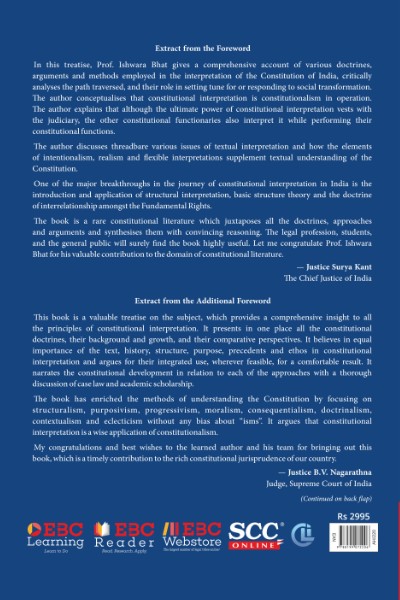
Extract from the Foreword
In this treatise, Prof. Ishwara Bhat gives a comprehensive account of various doctrines, arguments, and methods employed in the interpretation of the Constitution of India...The author discusses threadbare various issues of textual interpretation and how the elements of intentionalism, realism, and flexible interpretations supplement textual understanding of the Constitution...The book is a rare constitutional literature which juxtaposes all the doctrines, approaches, and arguments and synthesises them with convincing reasoning...
- Justice Surya Kant
The Chief Justice of India
Table of Contents
Part I - General
1.Introduction to Constitutional Interpretation
2. How to Interpret the Constitution?
Part II - Culture, History and External Aids
3. Significance and Role of Culture in Constitutional Interpretation
4. A Discourse on Theories of Originalism and Living Constitution
5. Constitutional History as an Aid to Interpret the Constitution
6. Relevance of Constituent Assembly Debates in Constitutional Interpretation
7. Relevance and Application of International Law in Constitutional Interpretation
8. Role of Foreign Precedents and Comparative Study in Constitutional Interpretation
9. Aid of Dictionaries, Encyclopaedia, Commentaries and Mimamsa in Constitutional Interpretation
Part III - Textual Interpretation and Internal Aids
10. Textualism in Constitutional Interpretation: Facets, Antinomies and Significance
11. Canons and Maxims in Constitutional Interpretation
12. Presumptions in Constitutional Interpretation
13. Role of Internal Aids in Constitutional Interpretation: Preamble, Heading, Marginal Note and the Value-expressive Resources
14. Internal Aids: Interpretive Clauses
15. Effect of Unconstitutionality: Doctrines and Their Application
16. Reading Techniques to Save the Constitutionality: Reading Down, Reading Up and Reading Into - Is There Space for Writing Anew?
Part IV - Structuralism
17. Role of Structuralism in Constitutional Interpretation (Part I): Concept, Comparison, Rule of Law, Remedies, and Separation of Powers
18. Role of Structuralism in Constitutional Interpretation (Part II): Federalism, Democracy, Basic Structure Theory and Inter-organ Controls
19. Interpreting the Distribution of Legislative Powers: Articles 245 to 253 and 301 to 305
20. Characterisation of Law: The Doctrines of “Colourable Legislation” and “Pith and Substance”
21. Doctrine of Repugnancy
22. Holistic and Harmonious Interpretations of the Constitution: Relations as Resources of Meaning
Part V - Value-based Interpretation
23. Purposive Construction of the Constitution
24. Progressive Interpretation of the Constitution: Ideology, Application and Efficacy
25. Consequentialist Construction of the Constitution: Nature, Methods and Potentialities
26. Moral Reading of the Constitution: Ideas, Practices and Outcomes
27. Feminist Constitutionalism and Interpretation for Empowering Women and Sexual Minorities
Part VI - Other Methods of Constitutional Interpretation
28. Role of Doctrinalism in Constitutional Interpretation
29. Role of Pragmatism in Constitutional Interpretation
30. Role of Contextualism in Constitutional Interpretation: The Expanding Circles
31. Pluralistic Theory of Constitutional Interpretation and Eclecticis2
Part VII - Conclusions
32. Conclusions
Appendix
Subject Index


|

Click on TITLE to choose available options.
|
|
Click on TITLE to choose available options.
|

|
Click on TITLE to choose available options.
|

|
Click on TITLE to choose available options.
|

|
Click on TITLE to choose available options.
|
|
Click on TITLE to choose available options.
|

|
|

|
Click on TITLE to choose available options.
|
|
Click on TITLE to choose available options.
|
|
||
|
||
|