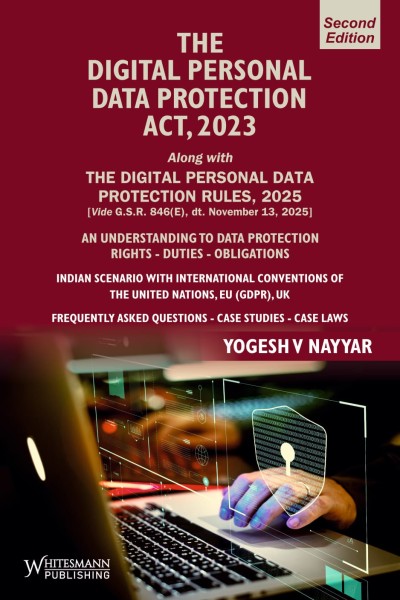
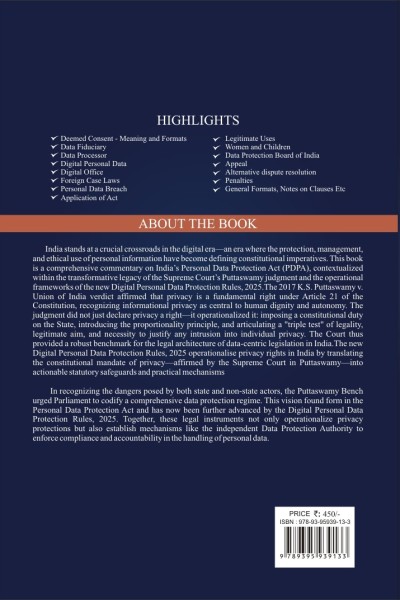
India stands at a crucial crossroads in the digital era-an era where the protection, management, and ethical use of personal information have become defining constitutional imperatives. This book is a comprehensive commentary on India's Personal Data Protection Act (PDPA), contextualized within the transformative legacy of the Supreme Court's Puttaswamy judgment and the operational frameworks of the new Digital Personal Data Protection Rules, 2025. The 2017 K.S. Puttaswamy v. Union of India verdict affirmed that privacy is a fundamental right under Article 21 of the Constitution, recognizing informational privacy as central to human dignity and autonomy. The judgment did not just declare privacy a right-it operationalized it: imposing a constitutional duty on the State, introducing the proportionality principle, and articulating a "triple test" of legality, legitimate aim, and necessity to justify any intrusion into individual privacy. The Court thus provided a robust benchmark for the legal architecture of data-centric legislation in India. The new Digital Personal Data Protection Rules, 2025 operationalise privacy rights in India by translating the constitutional mandate of privacy-affirmed by the Supreme Court in Puttaswamy-into actionable statutory safeguards and practical mechanisms
In recognizing the dangers posed by both state and non-state actors, the Puttaswamy Bench urged Parliament to codify a comprehensive data protection regime. This vision found form in the Personal Data Protection Act and has now been further advanced by the Digital Personal Data Protection Rules, 2025. Together, these legal instruments not only operationalize privacy protections but also establish mechanisms like the independent Data Protection Authority to enforce compliance and accountability in the handling of personal data.
Key Features:
- Thorough explanation of deemed consent, legitimate uses, and applicability of the DPDP Act.
- Detailed chapters on data fiduciaries, data processors, digital personal data, and digital offices.
- Covers the protection of women's and children's personal data under the Act.
- Includes foreign case laws and comparative global data protection references.
- Step-by-step coverage of the Data Protection Board of India and its functions.
- Discusses mechanisms for appeal, penalties, and alternative dispute resolution.
- Insights on personal data breaches, duties of entities, and compliance pathways.
- Includes general formats, notes on clauses, and practical interpretative guidance.
- Integrated analysis of the DPDP Rules, 2025, for real-world implementation.
This book is essential for lawyers, privacy professionals, data protection officers, policymakers, compliance managers, technology companies, consultants, academicians, and students specializing in cyber law, digital governance, and information privacy.


 Home > LAW BOOKS > Business Law > Information Technology & Cyber Law > Data Protection Laws


 5
5